




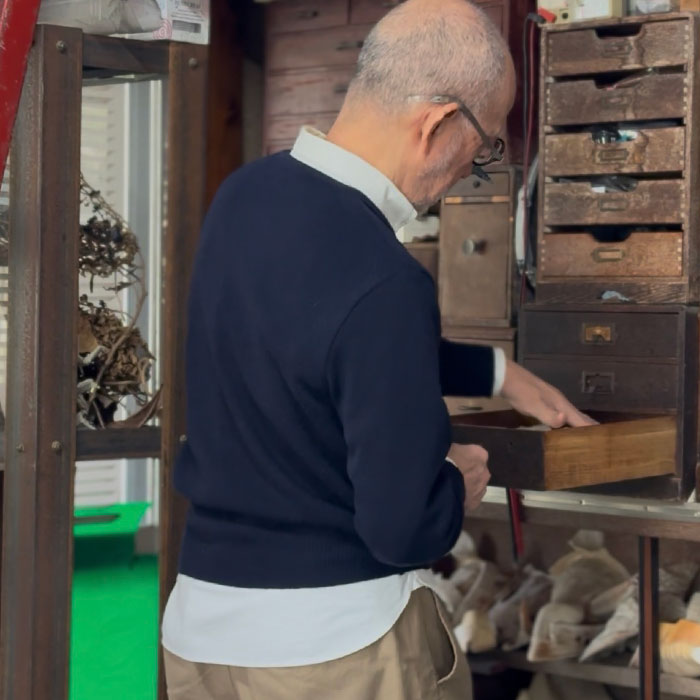
I was delighted to see Shinji Nakaba, one of the leading figures in contemporary jewelry, again three years after my first visit. After lunch with his charming wife, Noriko, we went into the studio to see the work he was creating for the exhibition “Japan, Stillness & Substance”.
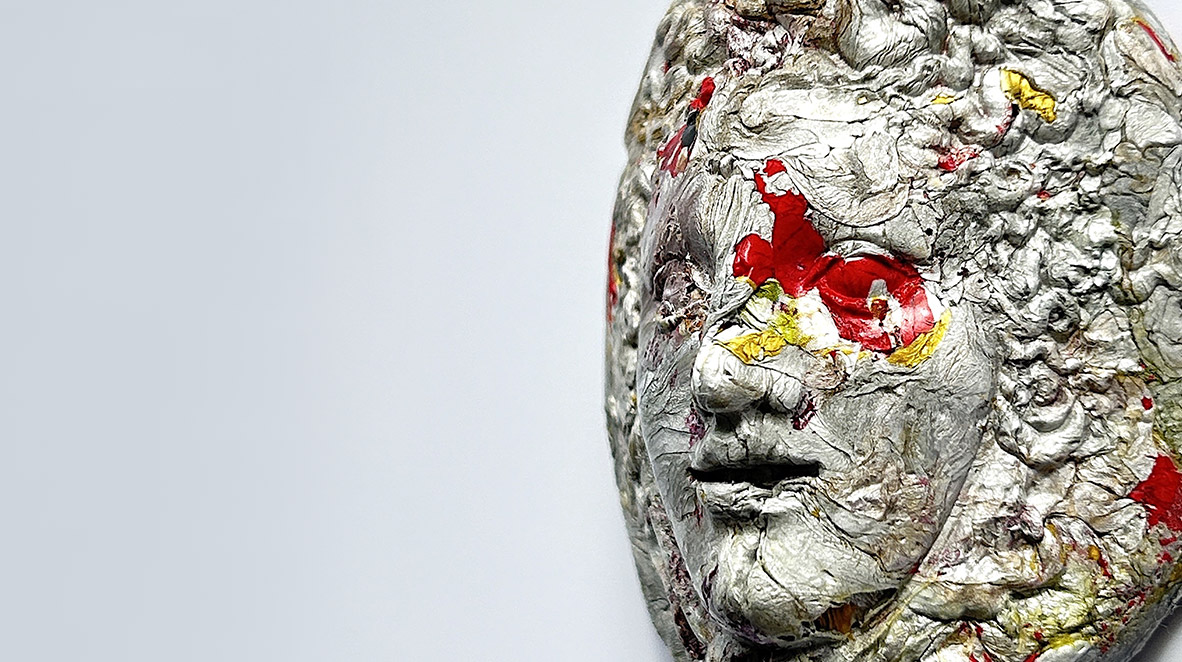
Müllgorgone, a Medusa Born of Waste
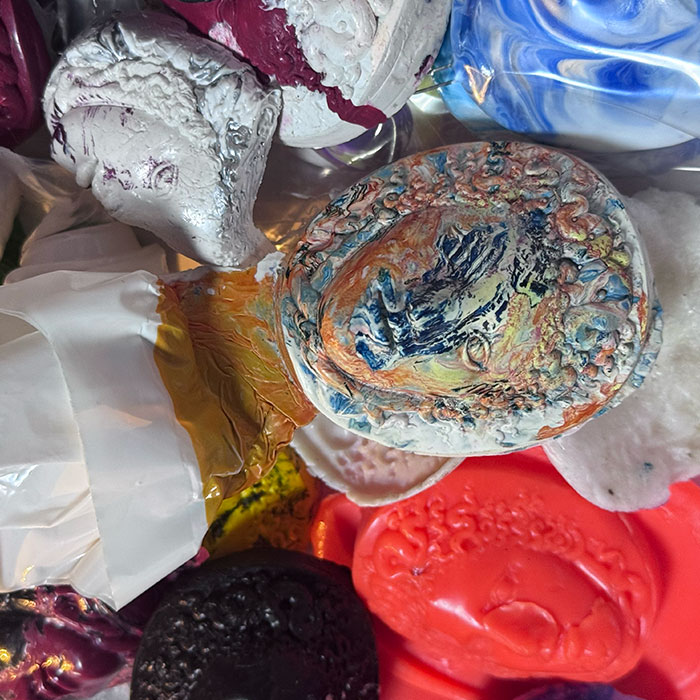
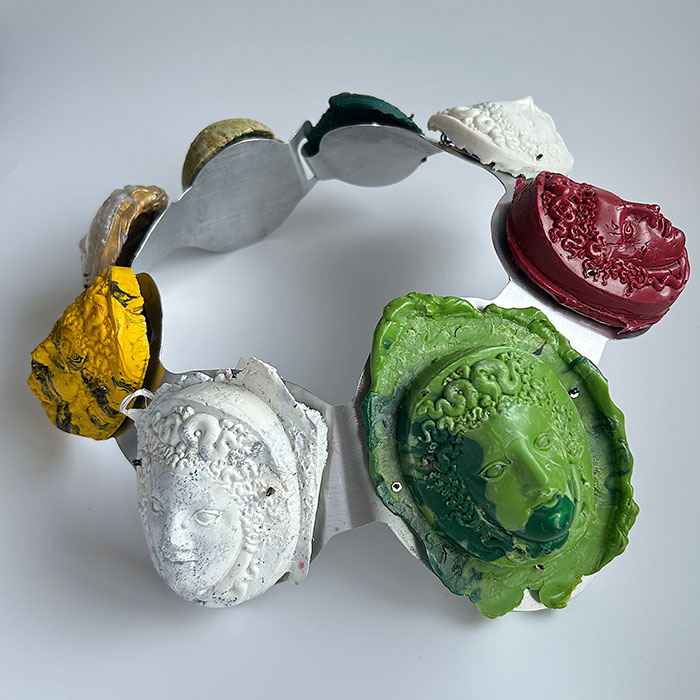
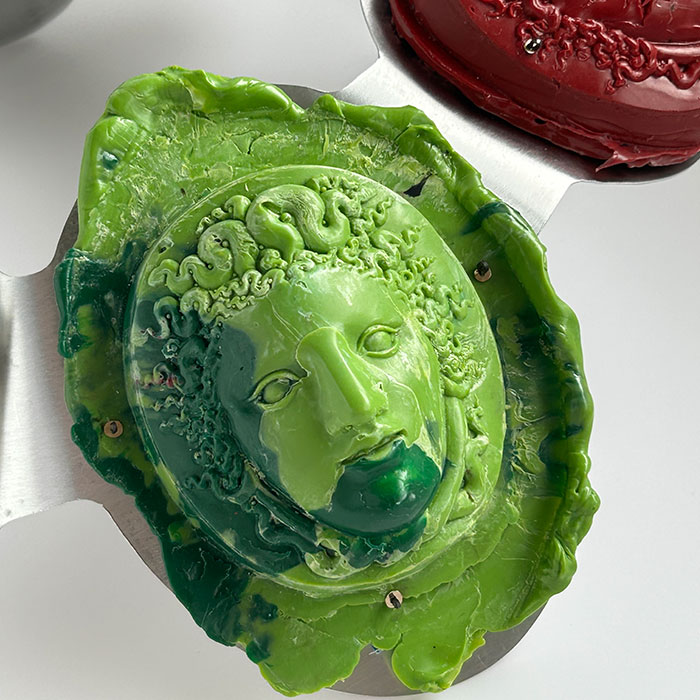
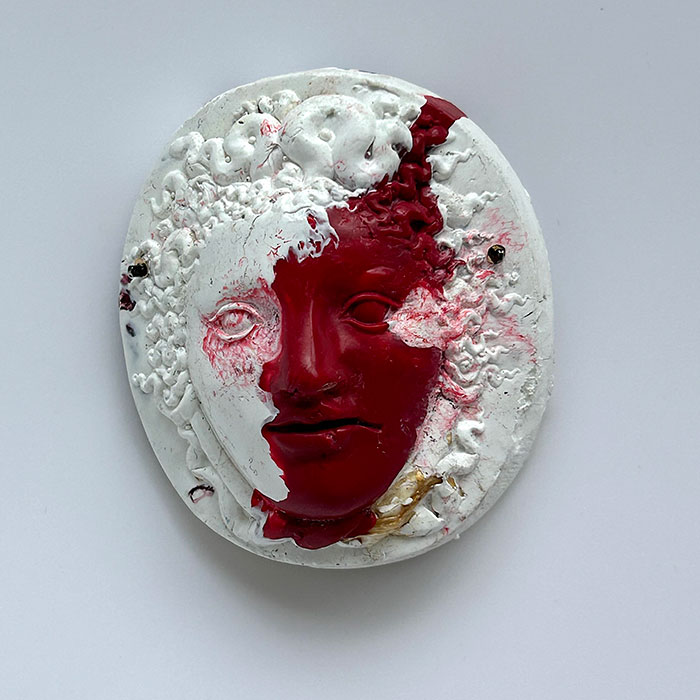
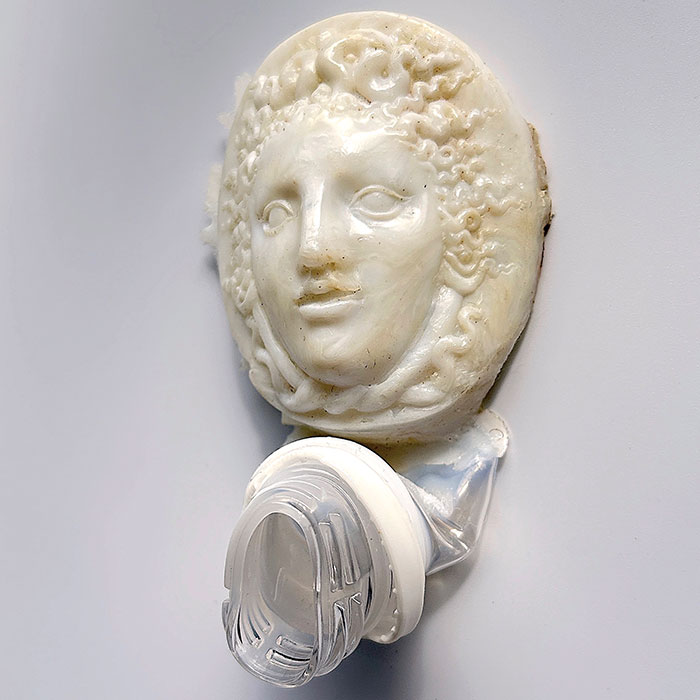
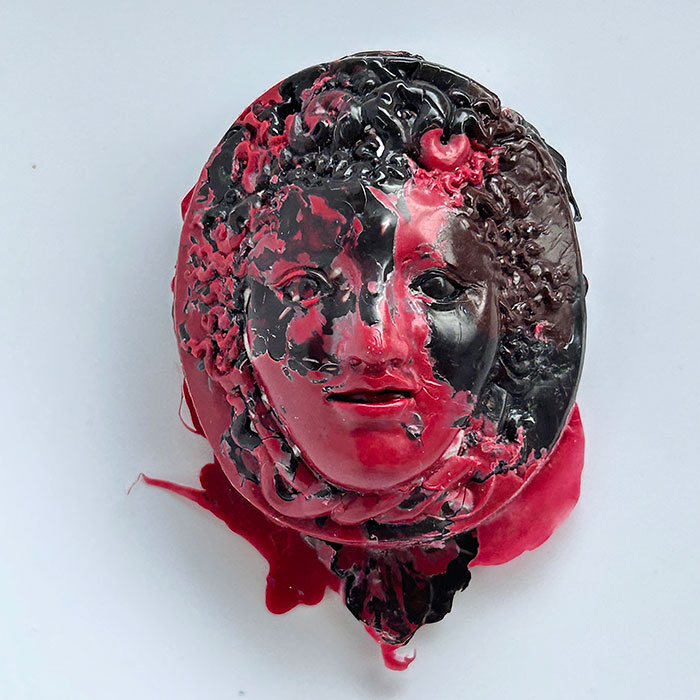
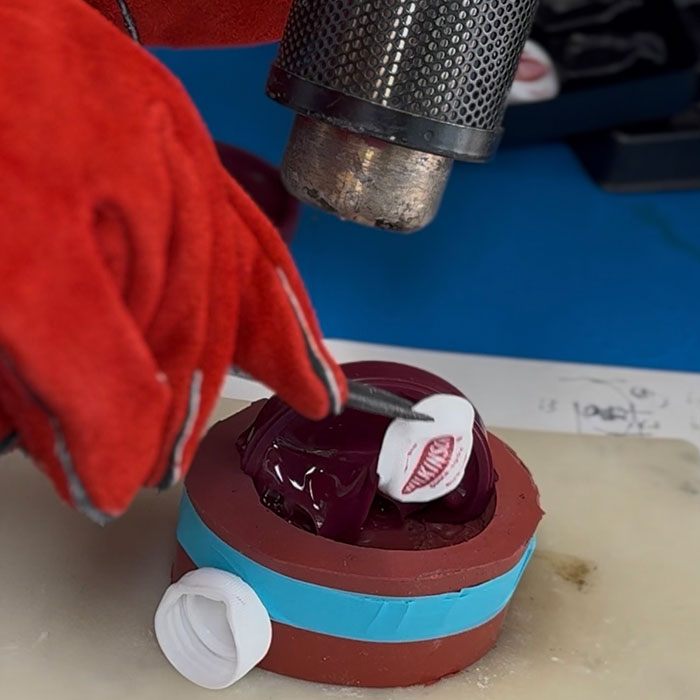
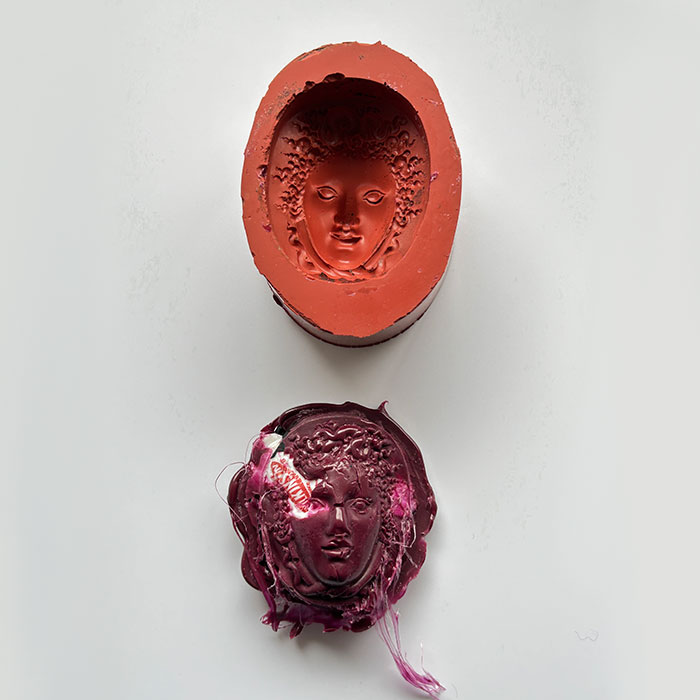
Shinji Nakaba presents Müllgorgone, a title combining the German word Müll, meaning “waste,” with the mythological figure of the Gorgon. This contemporary Gorgon, made from reclaimed plastic, grew out of a cameo depicting Medusa that Nakaba spent an entire year carving from a seashell. “I then made a silicone mold of the original cameo before melting shopping bags, bottles and their caps, and all kinds of packaging into it. The idea came to me while watching how vinyl records are made,” he explains after lunch, reaching for his heat gun. The mold makes it possible to reproduce the form endlessly, yet the material thwarts all repetition: variations in color, marbling, and chance irregularities make every cameo unique. These remnants of consumer culture acquire an unexpected beauty, at times resembling marble. Müllgorgone also evokes another monster: the endless cycle of desire, consumption, and disposal.
Reinventing Glyptic Art
To understand Müllgorgone, one must first consider Shinji Nakaba’s remarkable work with seashells. It is here that he demonstrates his mastery of glyptic art (the carving and engraving of hard materials), traditionally associated with raised cameos and recessed intaglios. Steeped in the study of antique jewelry and inspired by his admiration for Carl Fabergé, Nakaba nevertheless has no interest in reconstructing the past or conforming to conventions of what is beautiful, precious, or proper. In his hands, seashells give rise to feet, torsos, breasts, faces, and hands endowed with an uncanny vitality. These fragments of the body draw their power from classical sculpture without ever becoming mere quotations. Body, nature, desire, humor, and death mingle freely. This refusal to rank materials permeates his entire body of work. For the Chrysanthemum brooch (2024), now in the collection of mudac in Lausanne, Nakaba cut aluminum cans into discs, then painstakingly hammered them until the flower’s delicate vibrancy emerged.
Pearls, Between Mischief and Vanitas
Nakaba’s gift for glyptic art has earned recognition from major institutions such as the Museum of Fine Arts, Boston. The Moon and Angel (2021) brooch [1] brings together the faces of the Moon and the Angel in a silent tête-à-tête; their gentleness and strangeness lend the scene a dreamlike poetry. His Fairy Skulls—tiny skulls carved entirely by hand—have achieved worldwide success and become emblematic of his work. In the hollows and bulges of irregular freshwater keshi pearls, he searches for the shape of a mouth, a pair of eye sockets, or the curve of a skull. He then sketches the image before carving into the nacre. The appeal of the Fairy Skulls, which recall Western vanitas imagery, lies in the good-natured charm of their tender, mischievous faces. Long eyelashes and tufts of hair drawn in black ink add a note of humor. Nakaba blurs the boundary between the world of the living and the world beyond: the pearl’s luster seems to hold these figures in an uncertain state, suspended between appearance and disappearance. With discarded household plastics, he conjures the same presence.
[1] The work belongs to the Danner Foundation’s international collection of contemporary jewelry. A rotating selection from the collection is displayed at the Pinakothek der Moderne in Munich.
Click to learn more about my exhibition “Japan, Stillness & Substance” at Sotheby’s Paris from October 1–6, 2026, as part of Parcours Bijoux 2026, and explore Jewelry in Japan.
Opening talk (registration required) on October 1, 2026, at 6:00 p.m. at Sotheby’s Paris, with three of the artists in attendance : Shinji Nakaba, Aya Iwata, Mariko Sumioka.
This exhibition is part of Parcours Bijoux