


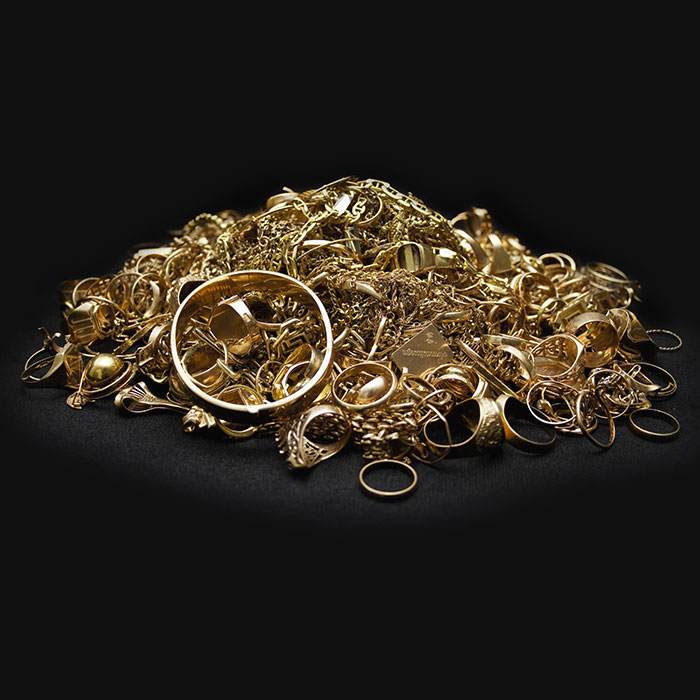
The French attachment to gold is well known. What is less widely known is that most of the gold they own is kept in safes in the form of jewelry. And, as the latest study commissioned by Francéclat reveals, they seem highly reluctant to part with it. Here is a closer look at this immobile market that the jewelry industry would like to set in motion again.
Par Sandrine Merle.
The Francéclat study began with a simple question. Since early 2023, the price of gold has risen spectacularly, climbing from around $1,800–$1,900 an ounce to more than $4,000 in 2026, setting a succession of historic records [1]. In such a context, smelters, refiners and industry professionals might have expected a massive wave of resale. Yet it did not happen. “Smelters and refiners were surprised that resale flows did not follow the same proportions. Global recycling rose by only 3% in 2025,” explains Hervé Buffet, director general of Francéclat. If gold could bring its owners a small fortune, why is it not returning massively to the market? The first explanation that comes to mind is that the French are keeping their gold hidden, safely out of sight of the tax authorities. Another explanation lies in “the major wave of resale around 2009–2012, at the time of the first strong rise in gold prices after the financial crisis,” recalls Patrick Schein, CEO of Gold by Gold, a precious-metals refiner and trader, and co-founder of the Alliance for Responsible Mining. But the Francéclat study shows that other factors are also at play.
A Jewelry Treasure
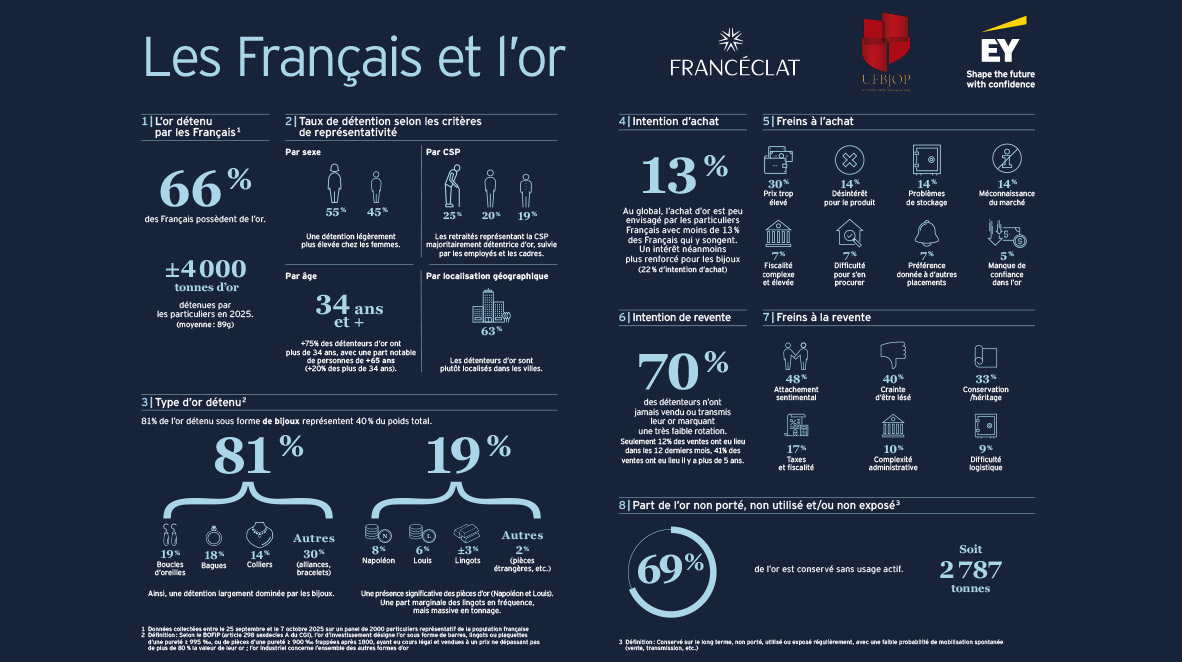
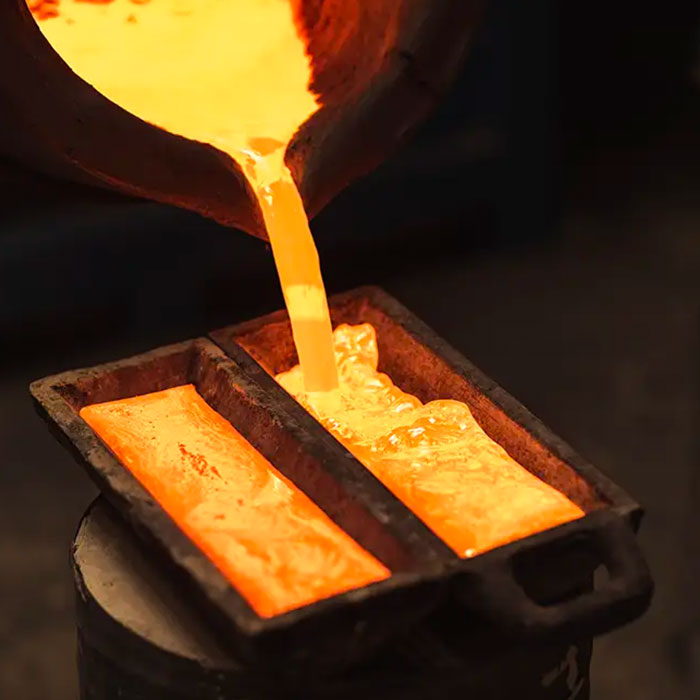
The study estimates the amount of gold held in France at 4,000 tons, roughly twice the official reserves of the Banque de France, which stand at 2,437 tons. Even more surprisingly, 81% of this gold in terms of the number of pieces, is reportedly held in the form of jewelry [2]. The study also reveals that 69% of this privately held gold — or 2,787 tons — is kept without any active use. It sleeps. It does not circulate, is not transformed, and does not return to the industry. Should we be concerned about this hoarding? From the point of view of liberal economists, any form of hoarding is a heresy, since values must circulate in order to create growth. For the jewelry industry, officially at least, these 4,000 tons represent a considerable resource already within reach, at a time when responsible sourcing has become a central issue. Gold has a rare quality: it can be melted, remelted, refined and reused endlessly without losing its properties. It never disappears; it simply changes form. As Hervé Buffet puts it with humor: “There may be gold in your wedding ring that once belonged to Vercingetorix. And tomorrow, it could be part of a new piece of jewelry.
Melt, Sell, Transform or Repair?
The question remains: why do the French find it so difficult to part with their gold? The study shows that emotion plays a central role: nearly one in two people keeps gold because it belongs to the intimate sphere. It is often a wedding ring, a baptism medal, or a ring associated with a departed grandmother. These objects cannot be reduced to their weight in metal. But attachment does not explain everything. For Hervé Buffet, one of the study’s most striking findings lies in the distrust of private owners: “40% explain their reluctance to resell their gold by the fear of being cheated. Yet the jewelry industry has organized circuits, with many jewelers, watchmakers and goldsmiths buying back jewelry.” These professionals therefore have a major educational role to play in rebuilding trust. This is where the real issue lies. They must help the French understand what they own: what deserves to be kept, repaired, transformed, passed down or sold. Not every forgotten piece of jewelry is a sentimental treasure. This is probably where the greatest room for action lies: in that grey area of forgotten, broken or mismatched jewelry.
Distinguishing the Untouchable from the Reusable
For industry professionals and public authorities, this stock represents a considerable resource. But should the French really be encouraged to sell their gold en masse? The money received could certainly finance immediate expenses — travel, home improvements, clothing and so on — but the French would risk impoverishing themselves further. “Once sold, gold generally leaves French patrimony, since India and China buy up the world’s yellow metal,” explains Patrick Schein. That gold would then leave the wealth accumulated in France over several generations and would no longer serve as a safe-haven asset, easy to preserve, pass on or, if necessary, take with oneself. This is precisely what explains the resistance of private owners. The study also mentions inheritance value as a barrier to selling. The fairest approach would therefore be to distinguish the untouchable from the reusable. A wedding ring, a baptism medal or a grandmother’s ring cannot be treated in the same way as a broken chain, a single mismatched earring or some forgotten piece of jewelry with no particular attachment.
This may be where the real margin for action lies: not in pushing the French to part with their patrimony, but in helping them understand what they own, and choose what they keep, what they pass on, what they repair, what they transform and what they put back into circulation.
[1] Since its peak in late January 2026, the gold price has fallen by just over 20%.
[2] By weight, 60% is investment gold—that is, bullion, Napoleons, etc.
To go further :
5 things you have to know about the impact of gold mining on nature
Gold Service’s recycled gold: an interview with Yann Bouillonnec