
Style

Aurélie Guillaume, illustrated enamel

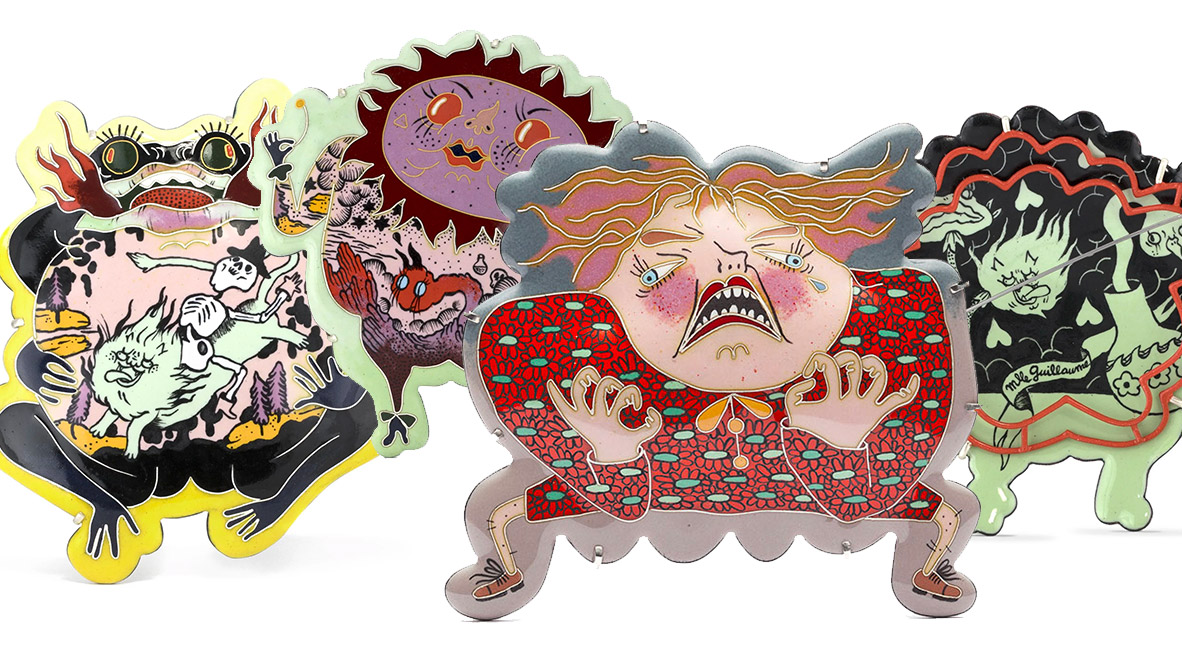
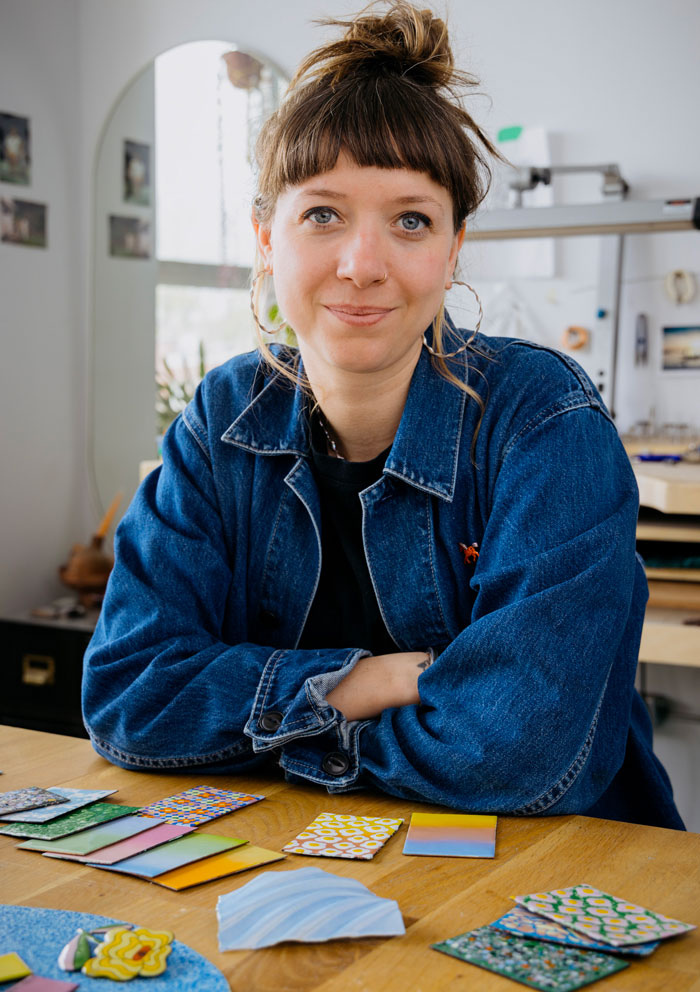
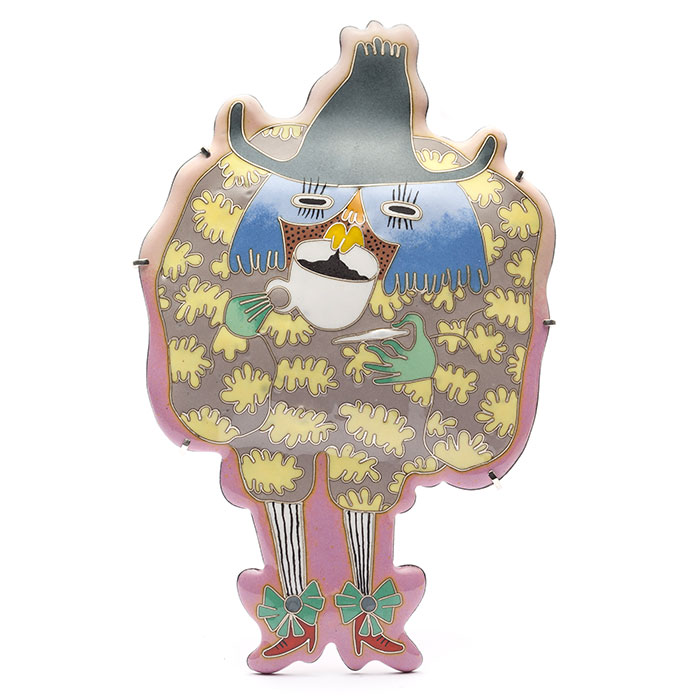
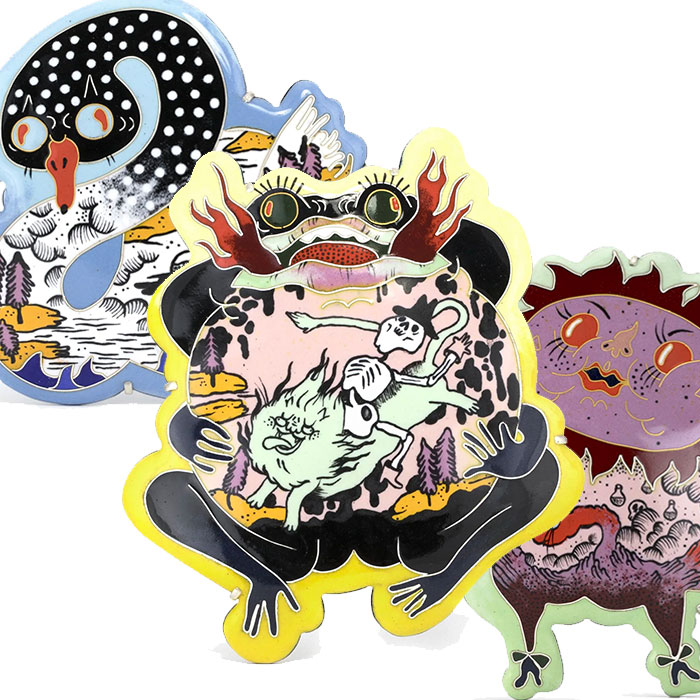
Influenced by comics and fashion illustration, Canadian artist Aurélie Guillaume brilliantly revives the ancient art of enamel. She invites us into a humorous world populated by colorful, whimsical characters.


Sandrine Merle. You were destined to be a fashion illustrator. How did you discover the technique of enamel?
Aurélie Guillaume. Like jewelry, a little by chance. I took an introductory class at the École de Joaillerie de Montréal and it was love at first sight. I was fascinated by this silica-based powder that, once fired, becomes a smooth, glossy, vitreous surface. Enamel offers endless color possibilities in a way gold and gemstones don’t. That said, it’s temperamental—and full of both happy and not-so-happy surprises. During my specialization at NSCAD University (Canada), I tried different techniques—grisaille, plique-à-jour, champlevé, and more—until I found the one that suited me best: cloisonné. I wouldn’t say it’s easier, but the fine silver wires that partition each color area let me keep the lines razor-sharp.


Sandrine Merle. Clouds with eyes, eccentric characters, bright colors, humorous messages. Your world resembles a children’s story. Where do you draw your inspiration?
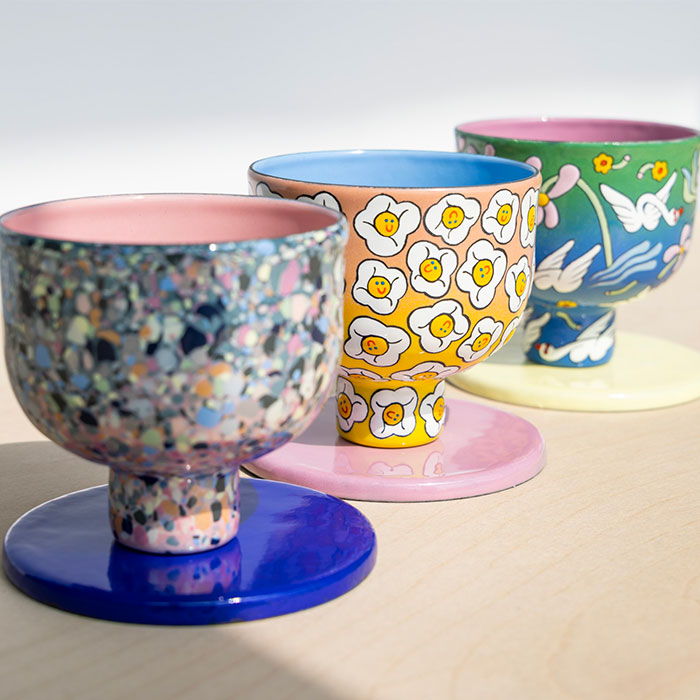
Aurélie Guillaume. I sometimes work to exhibition-led themes—as with The Alchemical Egg at Hannah Gallery (Barcelona), where each of three pieces represents a stage in the alchemical quest to turn lead into gold. Otherwise, I draw on everyday life: flowers in a park, insects darting through the grass, the feeling of calm after waking from a beach nap. My latest table pieces—tabletop works—evoke an imaginary picnic.


Sandrine Merle. In 2023, the series Les Masques Amoureux marked a turning point in your work.
Aurélie Guillaume. Having reached the limits of cloisonné for my purposes,

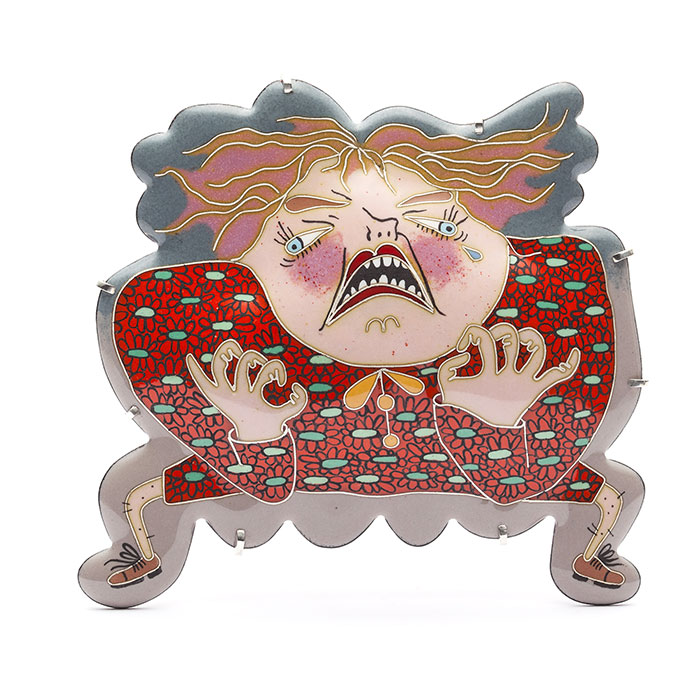
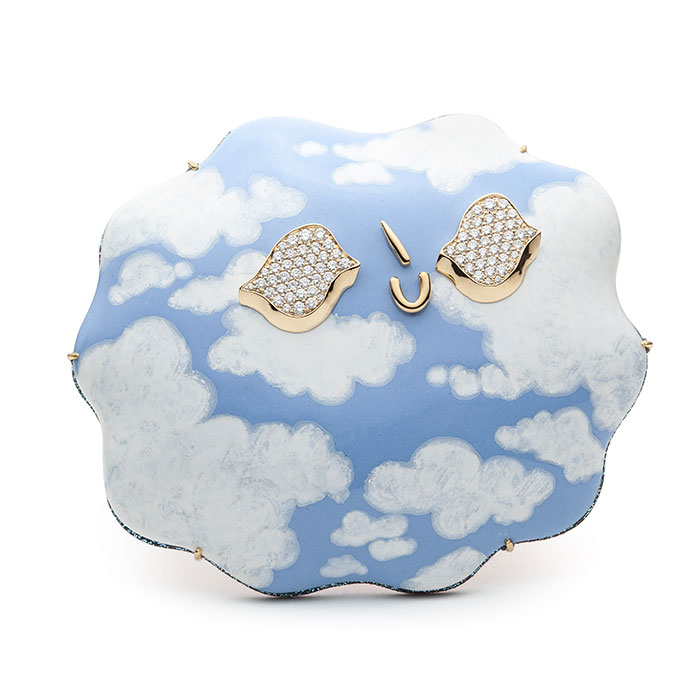
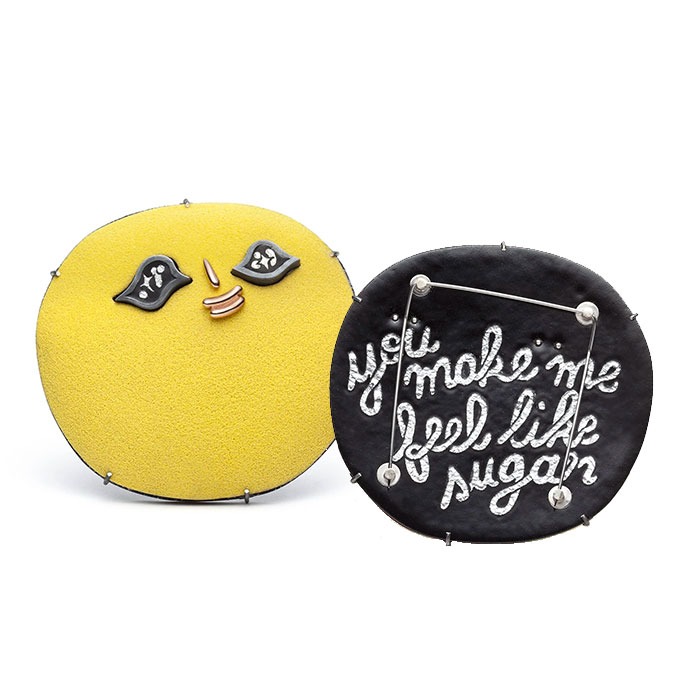
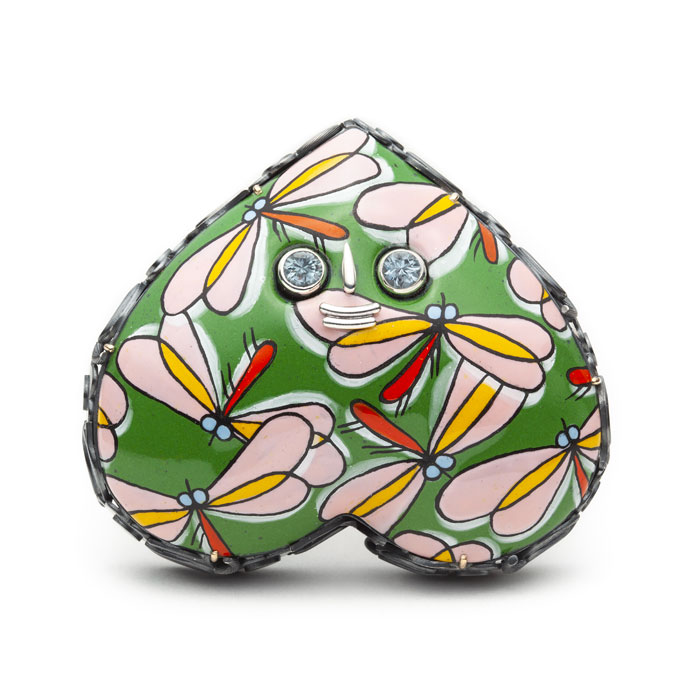
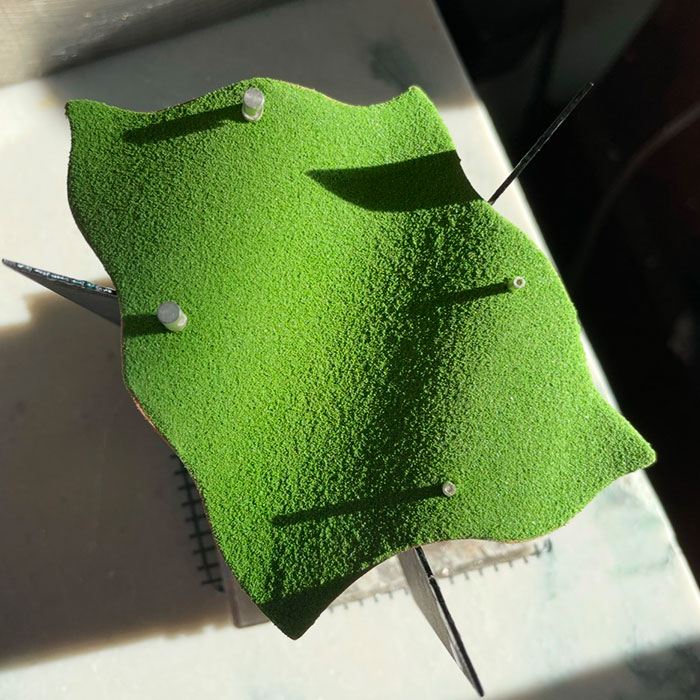
I chose to approach enameling differently: using wet-enamel application techniques, exploring texture, and letting the material speak more freely. I decided to welcome surprises—good or bad—along with atypical textures as compelling as smooth, shiny surfaces, and even the softening or blurring of my drawings. The brooch You Make Me Feel Like Sugar has a texture that is both rough and very soft (a sugar-coat effect); on Crushing Hard, the slightly softened flowers feel all the more lifelike. I let the material lead me—just as I let my feelings for the person I had just met. I even wrote bold messages such as “I’d like to bite your butt.” This was also when precious materials appeared: 24-karat gold beads mimicking freckles and a cloud with diamond eyes, recreating the dazzling reflections of sea and sun.


Sandrine Merle. You liken working with enamel to a form of meditation.
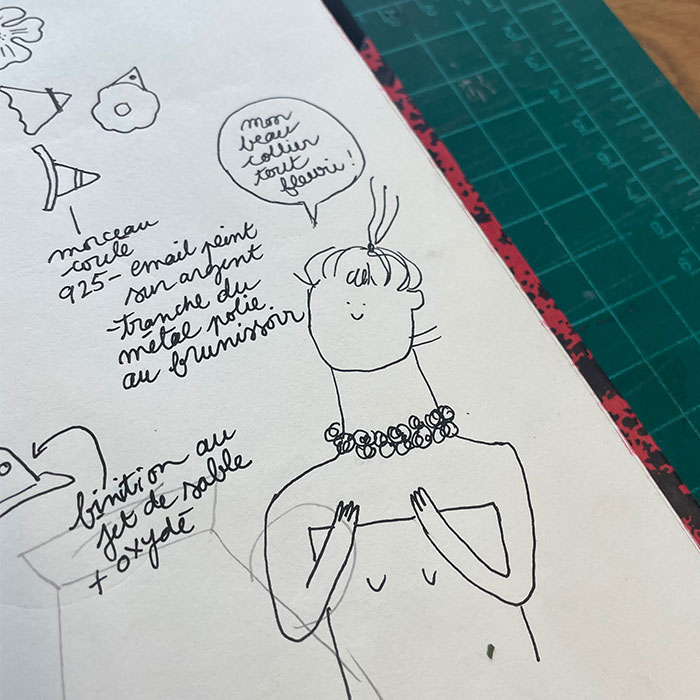
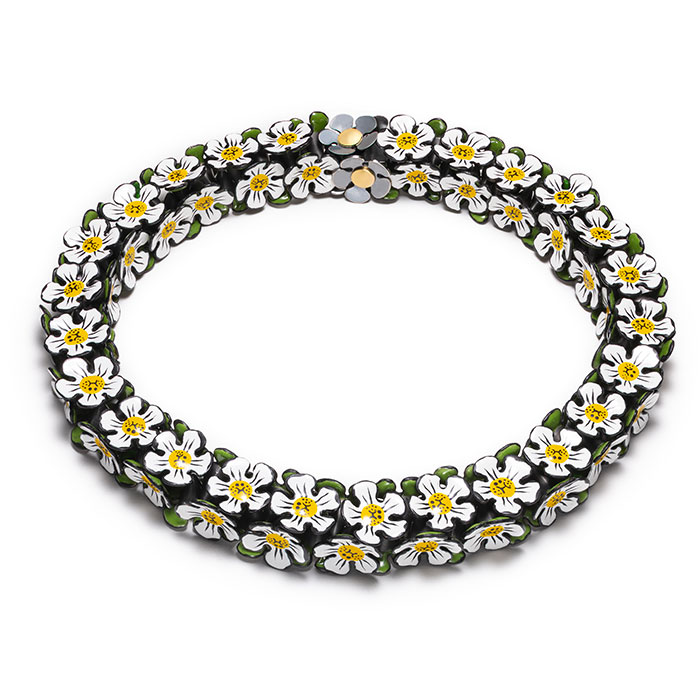
Aurélie Guillaume. Take the necklace Le secret des Marguerites, a ruffle of 102 small flowers: I sawed them from metal one by one, soldered each onto its little cone, then enameled them before stringing them on their cord. They belong to the same family, yet each has a different face. I loved this endlessly repetitive work, alone in the calm of my studio.


Sandrine Merle. At just 35, you’ve been invited to numerous exhibitions worldwide, and your pieces are in museum collections.
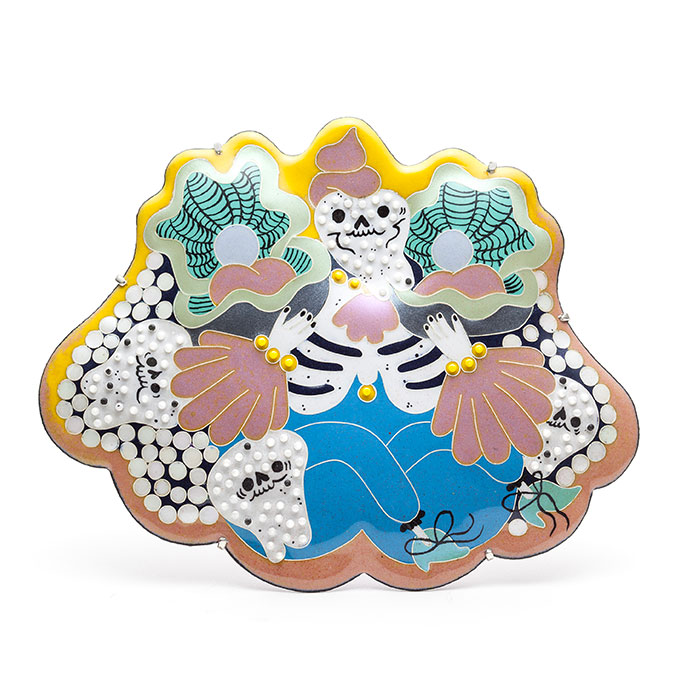
Aurélie Guillaume. It’s a tremendous honor, and I’m deeply moved. I was especially touched that my brooch Nous finirons tous au fond de la mer (We All End Up at the Bottom of the Sea) entered the collection of the Montreal Museum of Fine Arts—the city where I was born and where my parents met. Behind that slightly melancholic title and the figure playing with underwater creatures lies an intimate reference: a memory of my father, who died when I was a child, and the symbolic act of scattering his ashes. I didn’t want or understand it at the time; today, I see it differently.


Sandrine Merle. Who are your references in enamel?
Aurélie Guillaume. René Lalique and Carl Fabergé, of course, but also the 12th-century Limoges masters, whom I recently discovered at the Musée de l’Évêché in Limoges. They had only a coal-fired kiln and could control temperature only by watching the intensity of the flame. I also admire contemporaries like Jacqueline Ryan (England) and Aya Iwata (Japan).


Sandrine Merle. You have a loyal clientele of collectors. And yet you don’t give in to the temptation to produce more.
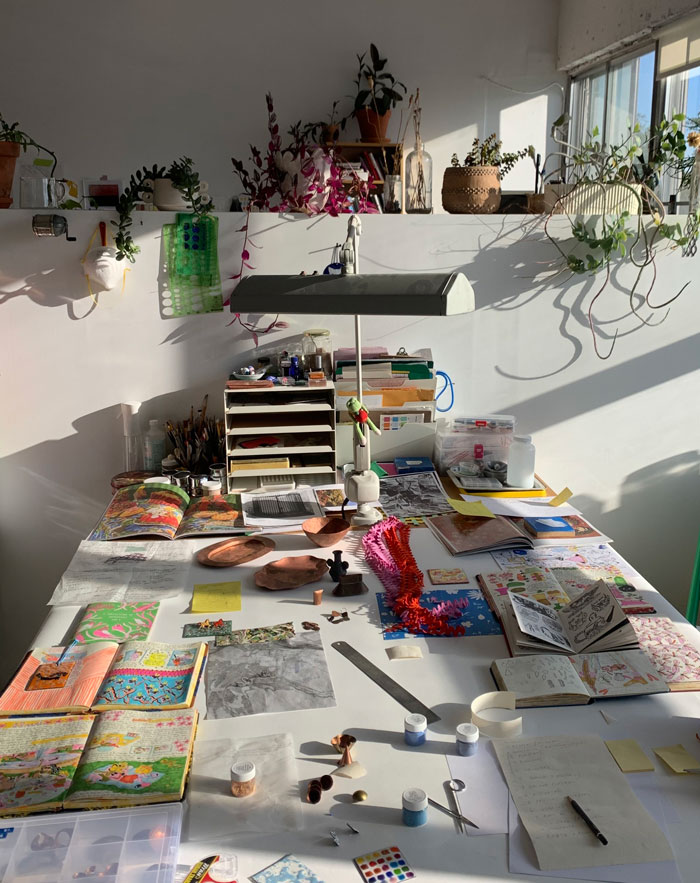
Aurélie Guillaume. I don’t make jewelry just to make jewelry. My sketchbooks are full, but not every drawing should become a jewel. Some years I create only five pieces, sold exclusively at Noel Guyomarc’h’s gallery. I want people to understand the meaning—and the time—behind both the conception and the making. For me, enamel is a quiet act of resistance to consumerism and obsolescence: objects unearthed after 2,000 years in perfect condition attest to that. I also need time to teach and pass the technique on, as others did for me; it’s thanks to them that it has endured and that I can do this work today.


Related articles:

Questions about contemporary jewelry 

An enamel plaque by Alexis Falize acquired by the MAD Paris

Jewelry: a plastic art

Influenced by comics and fashion illustration, Canadian artist Aurélie Guillaume brilliantly revives the ancient art of enamel. She invites us into a humorous world populated by colorful, whimsical characters.


Sandrine Merle. You were destined to be a fashion illustrator. How did you discover the technique of enamel?
Aurélie Guillaume. Like jewelry, a little by chance. I took an introductory class at the École de Joaillerie de Montréal and it was love at first sight. I was fascinated by this silica-based powder that, once fired, becomes a smooth, glossy, vitreous surface. Enamel offers endless color possibilities in a way gold and gemstones don’t. That said, it’s temperamental—and full of both happy and not-so-happy surprises. During my specialization at NSCAD University (Canada), I tried different techniques—grisaille, plique-à-jour, champlevé, and more—until I found the one that suited me best: cloisonné. I wouldn’t say it’s easier, but the fine silver wires that partition each color area let me keep the lines razor-sharp.


Sandrine Merle. Clouds with eyes, eccentric characters, bright colors, humorous messages. Your world resembles a children’s story. Where do you draw your inspiration?
Aurélie Guillaume. I sometimes work to exhibition-led themes—as with The Alchemical Egg at Hannah Gallery (Barcelona), where each of three pieces represents a stage in the alchemical quest to turn lead into gold. Otherwise, I draw on everyday life: flowers in a park, insects darting through the grass, the feeling of calm after waking from a beach nap. My latest table pieces—tabletop works—evoke an imaginary picnic.


Sandrine Merle. In 2023, the series Les Masques Amoureux marked a turning point in your work.
Aurélie Guillaume. Having reached the limits of cloisonné for my purposes,

I chose to approach enameling differently: using wet-enamel application techniques, exploring texture, and letting the material speak more freely. I decided to welcome surprises—good or bad—along with atypical textures as compelling as smooth, shiny surfaces, and even the softening or blurring of my drawings. The brooch You Make Me Feel Like Sugar has a texture that is both rough and very soft (a sugar-coat effect); on Crushing Hard, the slightly softened flowers feel all the more lifelike. I let the material lead me—just as I let my feelings for the person I had just met. I even wrote bold messages such as “I’d like to bite your butt.” This was also when precious materials appeared: 24-karat gold beads mimicking freckles and a cloud with diamond eyes, recreating the dazzling reflections of sea and sun.


Sandrine Merle. You liken working with enamel to a form of meditation.
Aurélie Guillaume. Take the necklace Le secret des Marguerites, a ruffle of 102 small flowers: I sawed them from metal one by one, soldered each onto its little cone, then enameled them before stringing them on their cord. They belong to the same family, yet each has a different face. I loved this endlessly repetitive work, alone in the calm of my studio.


Sandrine Merle. At just 35, you’ve been invited to numerous exhibitions worldwide, and your pieces are in museum collections.
Aurélie Guillaume. It’s a tremendous honor, and I’m deeply moved. I was especially touched that my brooch Nous finirons tous au fond de la mer (We All End Up at the Bottom of the Sea) entered the collection of the Montreal Museum of Fine Arts—the city where I was born and where my parents met. Behind that slightly melancholic title and the figure playing with underwater creatures lies an intimate reference: a memory of my father, who died when I was a child, and the symbolic act of scattering his ashes. I didn’t want or understand it at the time; today, I see it differently.


Sandrine Merle. Who are your references in enamel?
Aurélie Guillaume. René Lalique and Carl Fabergé, of course, but also the 12th-century Limoges masters, whom I recently discovered at the Musée de l’Évêché in Limoges. They had only a coal-fired kiln and could control temperature only by watching the intensity of the flame. I also admire contemporaries like Jacqueline Ryan (England) and Aya Iwata (Japan).


Sandrine Merle. You have a loyal clientele of collectors. And yet you don’t give in to the temptation to produce more.
Aurélie Guillaume. I don’t make jewelry just to make jewelry. My sketchbooks are full, but not every drawing should become a jewel. Some years I create only five pieces, sold exclusively at Noel Guyomarc’h’s gallery. I want people to understand the meaning—and the time—behind both the conception and the making. For me, enamel is a quiet act of resistance to consumerism and obsolescence: objects unearthed after 2,000 years in perfect condition attest to that. I also need time to teach and pass the technique on, as others did for me; it’s thanks to them that it has endured and that I can do this work today.


Related articles:

Questions about contemporary jewelry 
An enamel plaque by Alexis Falize acquired by the MAD Paris

Jewelry: a plastic art

Most read articles