


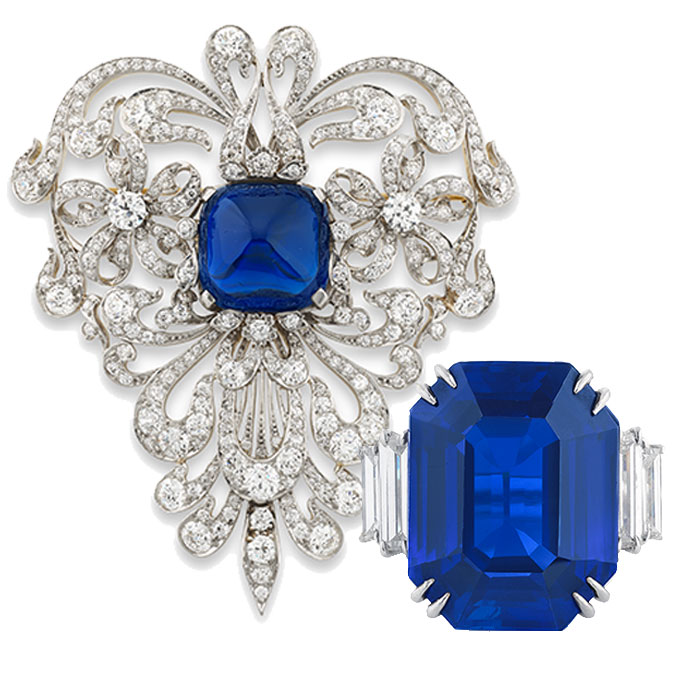
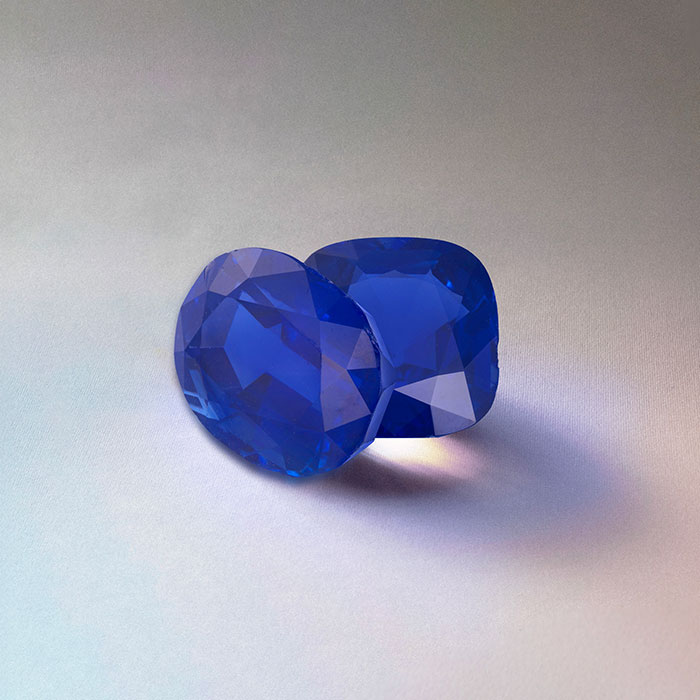
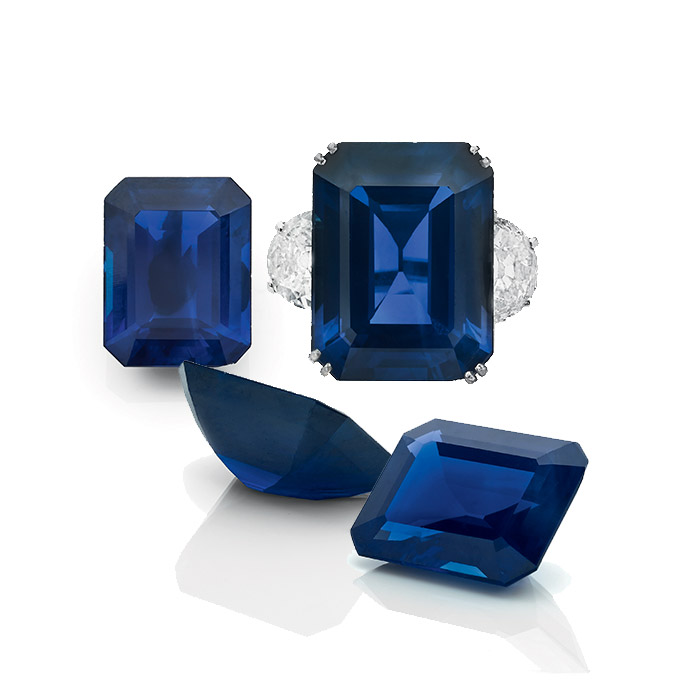
On November 10, Phillips auction house will sell two superb sapphires of the most prestigious origin: Kashmir.
By Sandrine Merle.
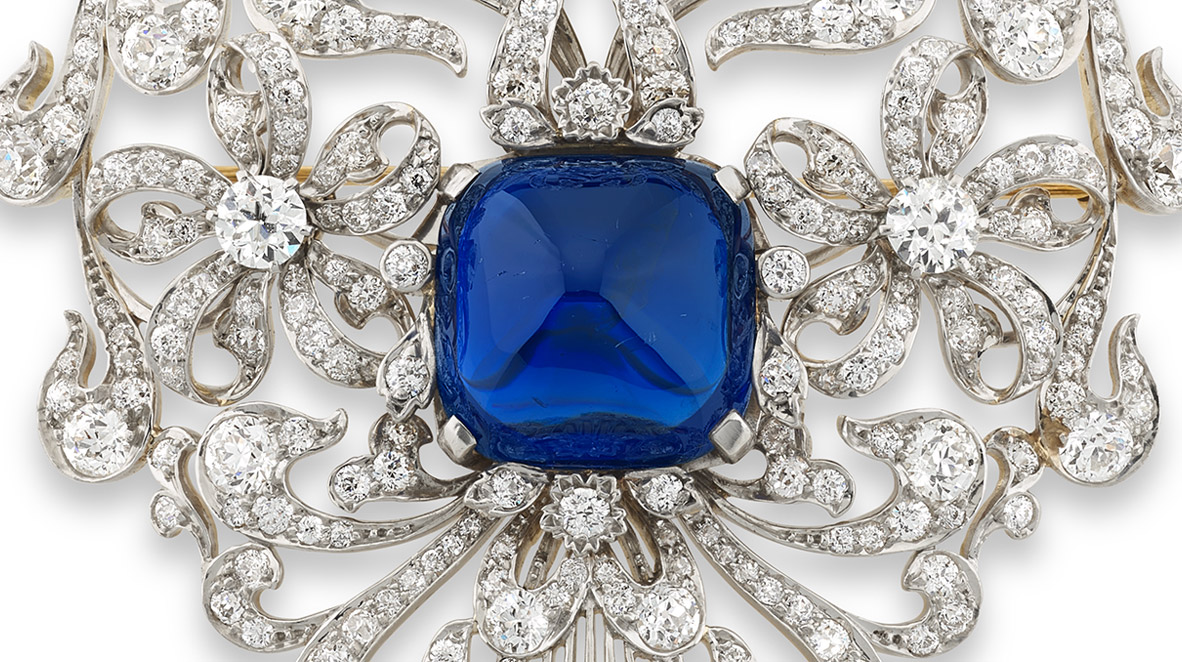
The first sapphire, the 43-carat “Vanderbilt,” is the subject of a special promotion because of its exceptional pedigree. Enhanced by a sugar loaf cabochon (i.e., polished on four sides), its Royal Blue color is among the most sought after. Preserved since the late 19th century by the Vanderbilt family, one of the most prominent families of the American aristocracy of the 19th century, it adorns the center of a brooch designed by Tiffany & Co. Less publicized and without any particular provenance, the second cut stone weighs only 18.09 carats and is set on a simple ring. And yet, it is estimated to be more expensive per carat than the “Vanderbilt”: $121,600/$155,000 compared to $23,430/$35,145. How can this paradox be explained?
The advantage Old mines
Let’s first examine the market, which is more favorable than ever to Kashmir sapphire, considered the most beautiful and prestigious. This unique color, a pure, velvety blue, is explained by a unique combination of trace elements of titanium and iron (as in other blue sapphires); it is further characterized by tiny particles organized in bands that diffract light in the same way that molecules in our atmosphere do to give the sky the color we know. These are what diffract the light. The aura of Kashmir sapphires also stems from the fact that they come from ancient mines, having been extracted at the end of the 19th century from a mine that was only worked for ten years. Located at an altitude of 4,500 meters, it was only accessible in July and August at the time. The Maharaja of Kashmir had a monopoly on it, offering the largest stones to the British aristocracy summering in the valley. “Sapphires from Sri Lanka, on the other hand, were available to all travelers,” compares gemologist Vincent Pardieu.
Belonging to the colored stones category
Kashmir sapphires are even more sought after given the phenomenal craze for colored stones. “Between 2005 and 2015, prices had already risen by 30-40% and they have never stopped climbing,” recalls Claire-Laurence Mestrallet, director of the Adams auction house. Since 2022, the fall in diamond prices has reinforced this craze. Buyers about to spend crazy amounts of money need reassurance: for a colored stone, they now demand not one but several analysis reports covering purity, weight, origin, etc. Opinions may differ as techniques and knowledge evolve. Vincent Pardieu gives the example of Madagascan and Sri Lankan sapphires, which in 1992/1995 and 2016/2017 were often confused with those from Kashmir. Under pressure, auction houses now provide at least two reports from internationally renowned entities such as the Swiss Gübelin and SSEF. The Vanderbilt has three!
The paradox of the two sapphires on sale at Phillips
The value of a stone does not depend solely on its analysis report or provenance. Its size also plays a role, hence the paradox of the two sapphires sold by Phillips. “Even magnificent cabochon stones, i.e., polished stones, generally fetch slightly lower prices per carat than faceted stones,” notes Benoît Repellin, global director of Phillips’ jewelry department. Without really knowing why… Cabochons are less fashionable than they were in the 1980s, when Paloma Picasso, Marina B. Bulgari, and Mauboussin were all fans. Today, buyers prefer faceted cuts that maximize brilliance, such as cushion, oval, and navette. Vincent Pardieu also sees this as “a consequence of the influence of the ultra-powerful diamond industry, which is forced to facet this stone because it is too hard to simply polish, and who knew how to promote brilliance and purity to compensate for the absence of color.”
Today, no one can estimate the number of carats extracted from this legendary mine in the 19th century. Have they all already been sent to laboratories and/or sold? Are there still some left in vaults, as auction houses believe? Should we believe the rumor that the Maharajah’s descendants keep bags full of stones in Geneva’s Port-Franc, which they dip into when needed? It’s a mystery…
Relative articles:
“Inside Out: Journey into the center of a gem” with Billie Hughes
Colored diamonds: flawed is beautiful