
Style

Four Artists Transforming Banknotes into Jewelry

While coins made of precious metal have been set into jewelry since Antiquity, largely because of their intrinsic value, the same is clearly not true of banknotes. Yet today, four artists are turning this fragile, ephemeral material into surprising creations.

While coins made of precious metal have been set into jewelry since Antiquity, largely because of their intrinsic value, the same is clearly not true of banknotes. Yet today, four artists are turning this fragile, ephemeral material into surprising creations.

By Sandrine Merle.


Benedict Haener

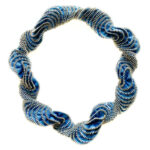
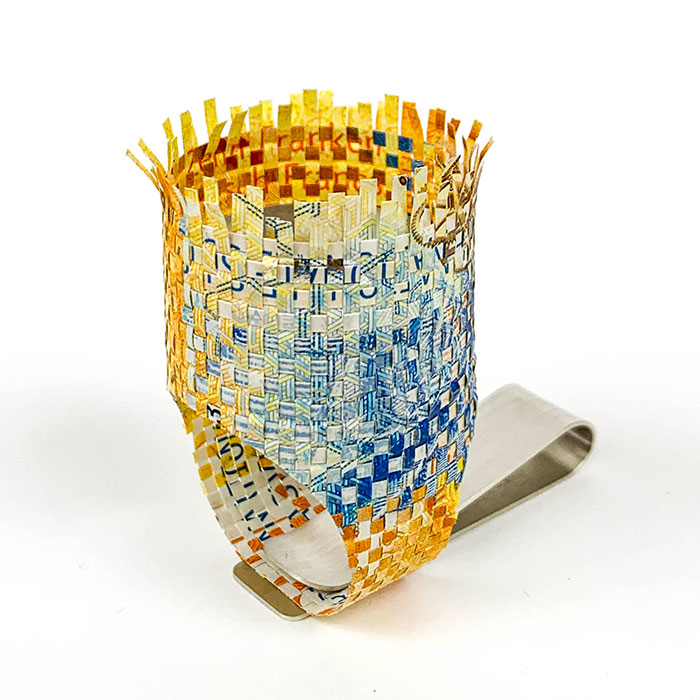
For Swiss artist Benedict Haener, the process begins with the destruction of Swiss banknotes into confetti, before he reassembles the resulting strips into rings or pendants using gold or silver. “Thanks to considerable manual work, new poetic pieces are born from these fragments without value. A revaluation takes place, moving from monetary value to emotional value,” he explains. The artist nevertheless points to the ambiguity of this operation: “if one counts the hours of work, including the development of the concept, the object is not really ‘worth it’ — at least, not yet.” This paradox is precisely what makes his pieces so compelling. They show that value is never fixed: it depends on gesture, time, context, perception and the story that accompanies the object.


Tine De Ruysser, Money Makes the World Go Round

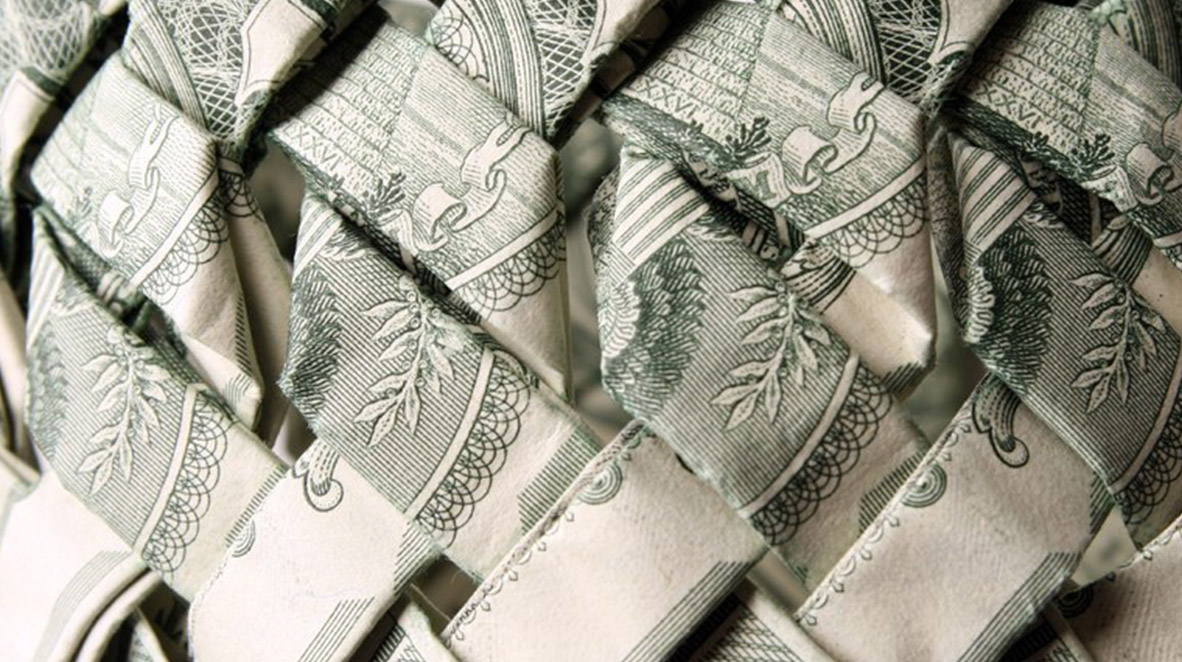
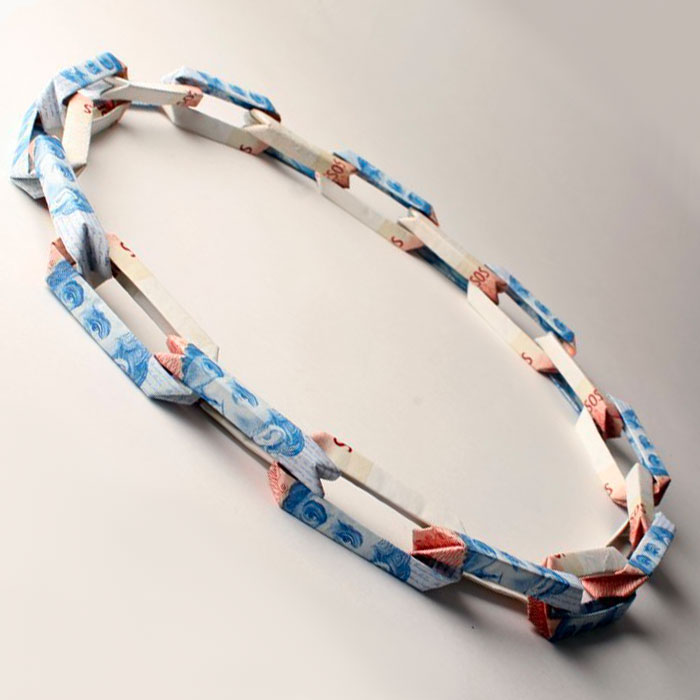
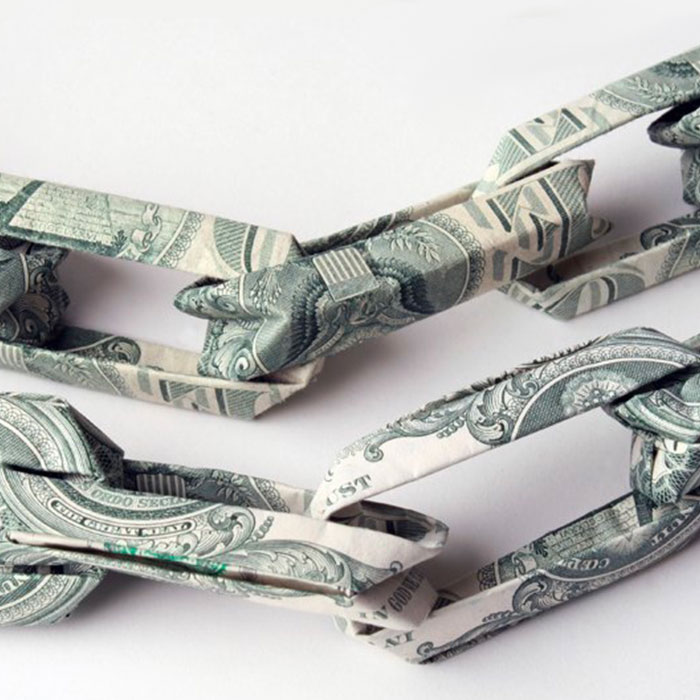
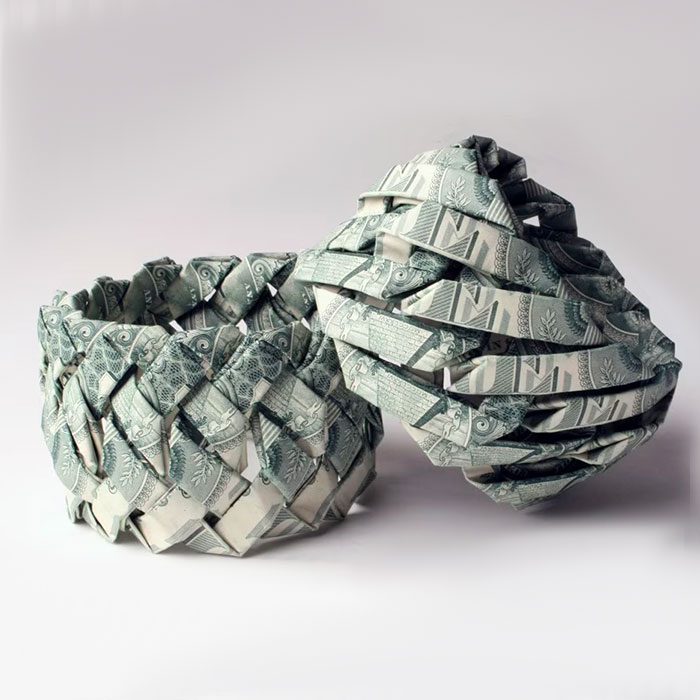
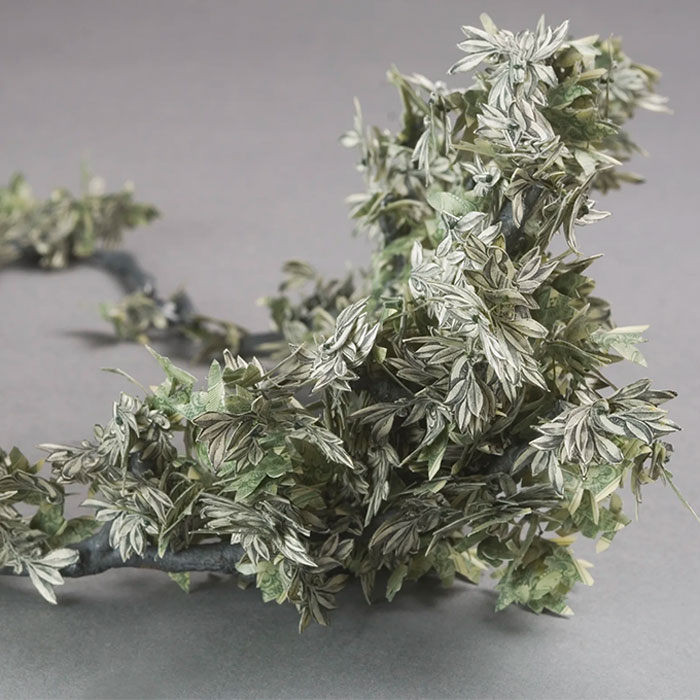
Artist Tine De Ruysser draws inspiration from moneygami, a practice that consists of folding banknotes like origami, popularized in the early 2000s by Japanese artist Yosuke Hasegawa. Her collection began with two pieces created for an exhibition at the Bank of America in London, before developing into a larger body of work titled Money Makes the World Go Round. The banknotes are folded in such a way that they are never fully visible, while remaining immediately recognizable as money. Sourced from different countries, they were all legal tender at the time of their transformation. Neither cut, glued nor damaged, they could theoretically, once unfolded, recover their original function and be used to pay. The project also originally had a participatory dimension: the artist invited the public to send her a banknote from their country of origin or from their latest holiday destination. The jewel thus became at once a monetary object, a geographical souvenir and a fragment of global circulation.


Lauren Tickle, Increasing Value

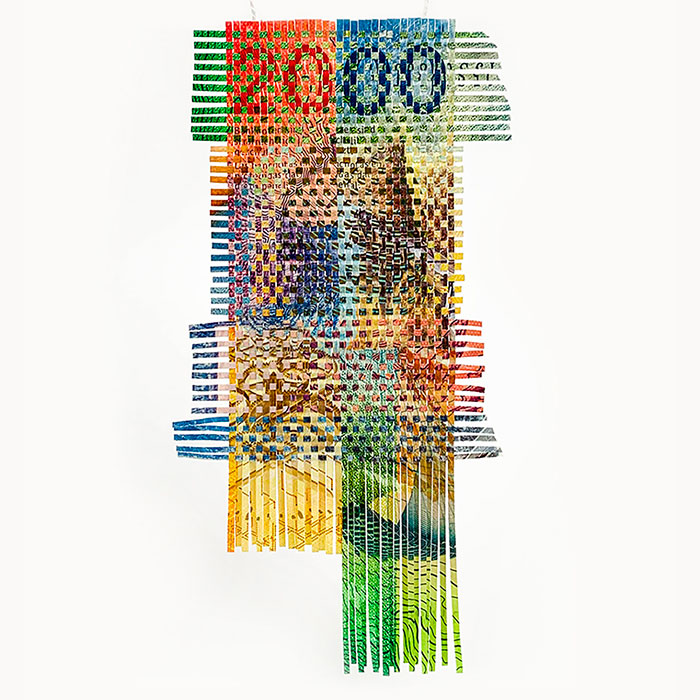
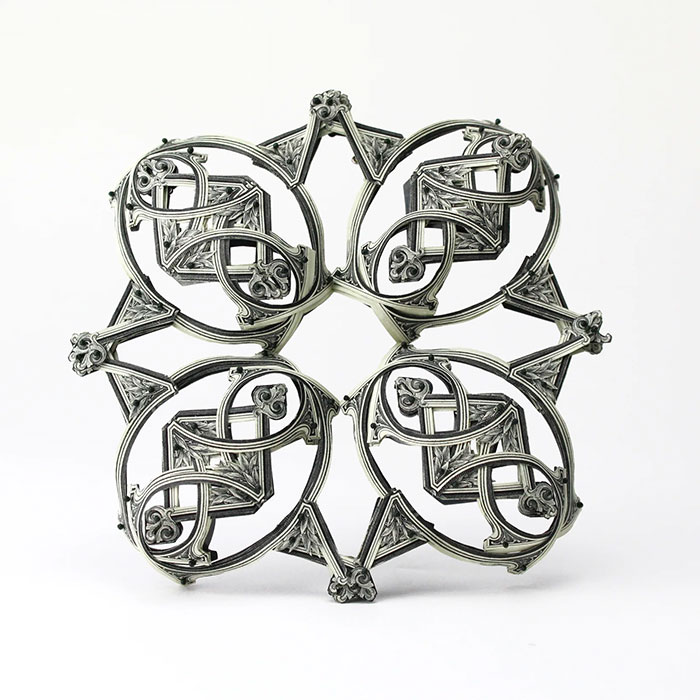
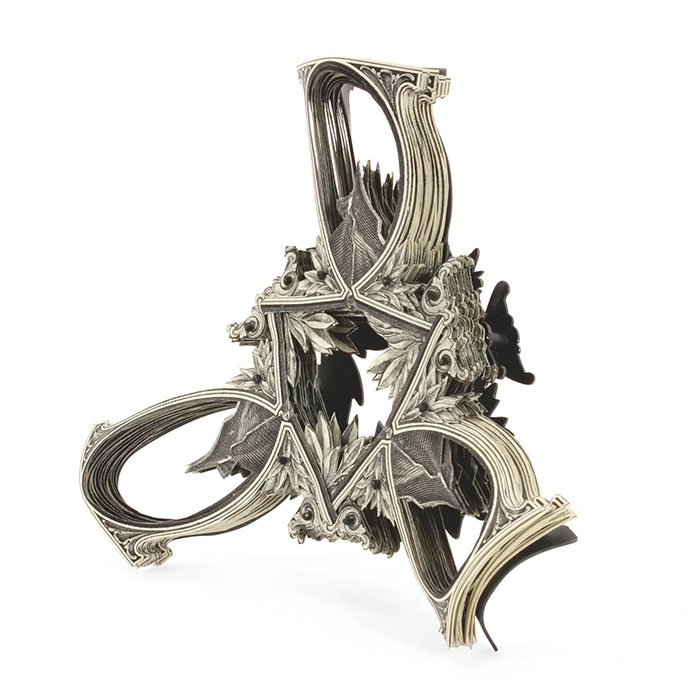
With her emblematic series Increasing Value, American artist Lauren Tickle works with out-of-circulation dollar bills, collected from banks, friends or clients. Destined for the shredder, these banknotes were supposed to disappear, reduced to simple strips of paper with no remaining connection to what they once were. The artist destroys them, reducing them to frames, arabesques and other fragments, which she arranges in kaleidoscopic layers. She never reveals the words, letters or numbers that would allow them to be identified, leaving viewers to draw their own conclusions about their value.


Carla Movia, 21 Grams

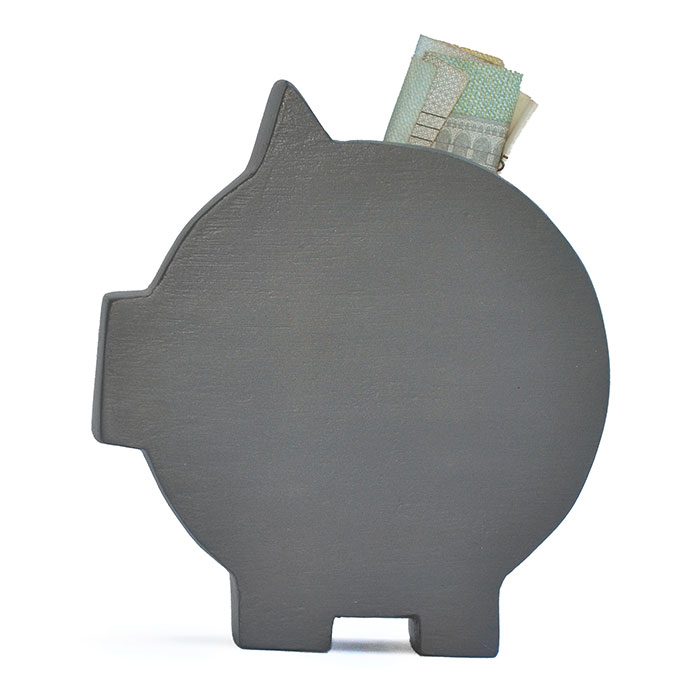
Created in 2018 for the traveling exhibition 21 Grams, organized by Ruudt Peters, this wooden piggy-bank brooch, from which a few banknotes emerge, responded to a precise brief: to create a jewel whose weight and substance would symbolically correspond to those of the soul — 21 grams. Italian artist Carla Movia takes as her starting point the notion of Anima Mundi, the soul of the world, theorized by Plato as a link between all living beings. But her observation of contemporary society leads her to a darker conclusion: today, the common bond may well be money. It controls actions, shapes opinions and conditions freedoms. Personal and collective battles are often fought in its name, at the cost of what is damaged or sacrificed. Here, the banknote no longer represents only exchange value. It becomes the sign of a force that organizes human relationships. The jewel asks what money can buy — even the soul itself.


Banner image: Tine De Ruysser


More articles on currency transformed into jewelry:
Coins and Jewelry at Citéco
Maria Kaprili, a legacy of motifs 

While coins made of precious metal have been set into jewelry since Antiquity, largely because of their intrinsic value, the same is clearly not true of banknotes. Yet today, four artists are turning this fragile, ephemeral material into surprising creations.

By Sandrine Merle.


Benedict Haener

For Swiss artist Benedict Haener, the process begins with the destruction of Swiss banknotes into confetti, before he reassembles the resulting strips into rings or pendants using gold or silver. “Thanks to considerable manual work, new poetic pieces are born from these fragments without value. A revaluation takes place, moving from monetary value to emotional value,” he explains. The artist nevertheless points to the ambiguity of this operation: “if one counts the hours of work, including the development of the concept, the object is not really ‘worth it’ — at least, not yet.” This paradox is precisely what makes his pieces so compelling. They show that value is never fixed: it depends on gesture, time, context, perception and the story that accompanies the object.


Tine De Ruysser, Money Makes the World Go Round

Artist Tine De Ruysser draws inspiration from moneygami, a practice that consists of folding banknotes like origami, popularized in the early 2000s by Japanese artist Yosuke Hasegawa. Her collection began with two pieces created for an exhibition at the Bank of America in London, before developing into a larger body of work titled Money Makes the World Go Round. The banknotes are folded in such a way that they are never fully visible, while remaining immediately recognizable as money. Sourced from different countries, they were all legal tender at the time of their transformation. Neither cut, glued nor damaged, they could theoretically, once unfolded, recover their original function and be used to pay. The project also originally had a participatory dimension: the artist invited the public to send her a banknote from their country of origin or from their latest holiday destination. The jewel thus became at once a monetary object, a geographical souvenir and a fragment of global circulation.


Lauren Tickle, Increasing Value

With her emblematic series Increasing Value, American artist Lauren Tickle works with out-of-circulation dollar bills, collected from banks, friends or clients. Destined for the shredder, these banknotes were supposed to disappear, reduced to simple strips of paper with no remaining connection to what they once were. The artist destroys them, reducing them to frames, arabesques and other fragments, which she arranges in kaleidoscopic layers. She never reveals the words, letters or numbers that would allow them to be identified, leaving viewers to draw their own conclusions about their value.


Carla Movia, 21 Grams

Created in 2018 for the traveling exhibition 21 Grams, organized by Ruudt Peters, this wooden piggy-bank brooch, from which a few banknotes emerge, responded to a precise brief: to create a jewel whose weight and substance would symbolically correspond to those of the soul — 21 grams. Italian artist Carla Movia takes as her starting point the notion of Anima Mundi, the soul of the world, theorized by Plato as a link between all living beings. But her observation of contemporary society leads her to a darker conclusion: today, the common bond may well be money. It controls actions, shapes opinions and conditions freedoms. Personal and collective battles are often fought in its name, at the cost of what is damaged or sacrificed. Here, the banknote no longer represents only exchange value. It becomes the sign of a force that organizes human relationships. The jewel asks what money can buy — even the soul itself.


Banner image: Tine De Ruysser


More articles on currency transformed into jewelry:
Coins and Jewelry at Citéco
Maria Kaprili, a legacy of motifs 
Most read articles