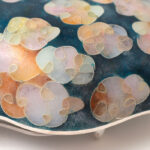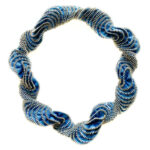



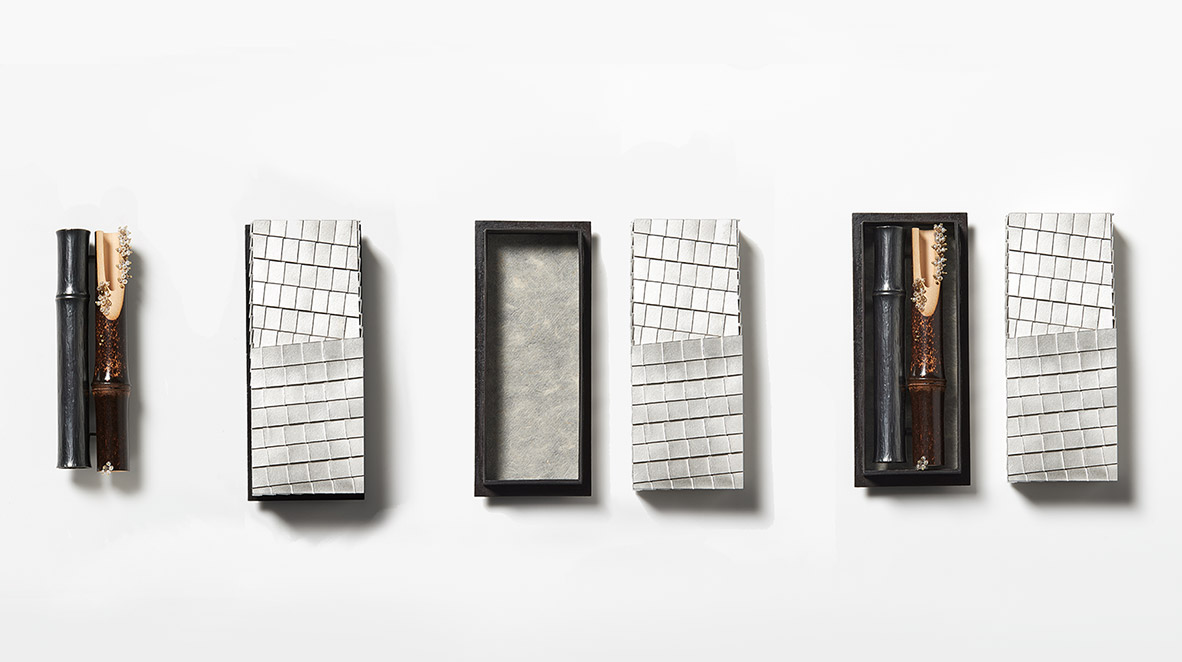
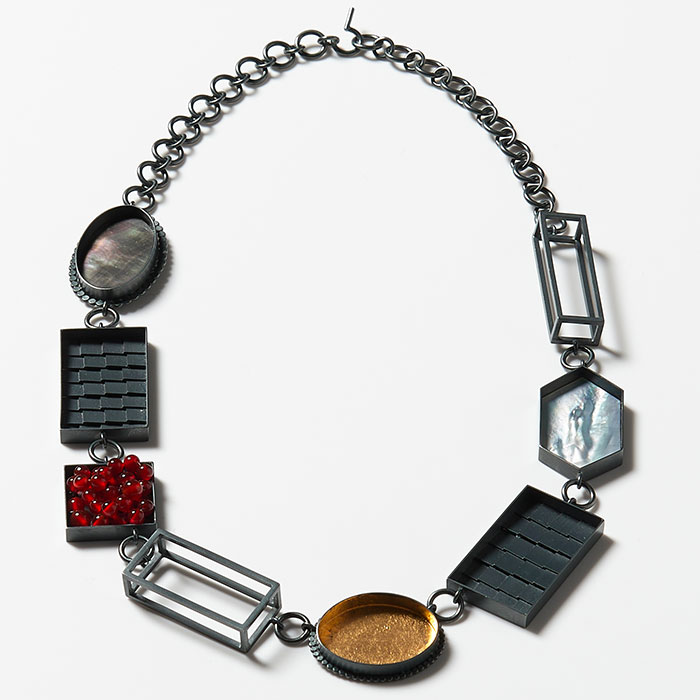
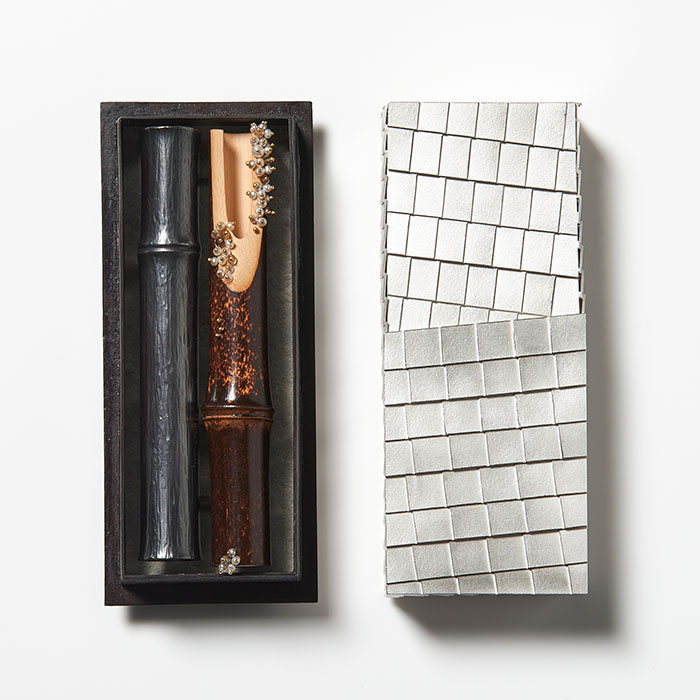
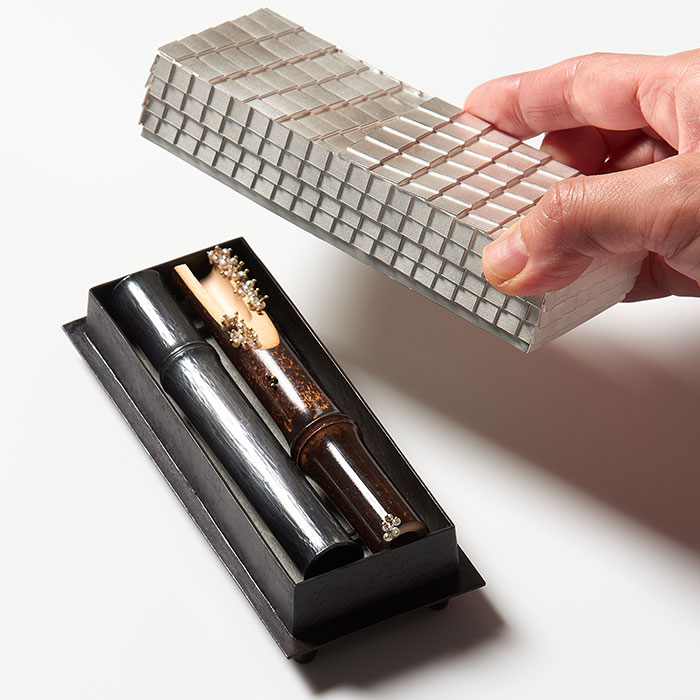
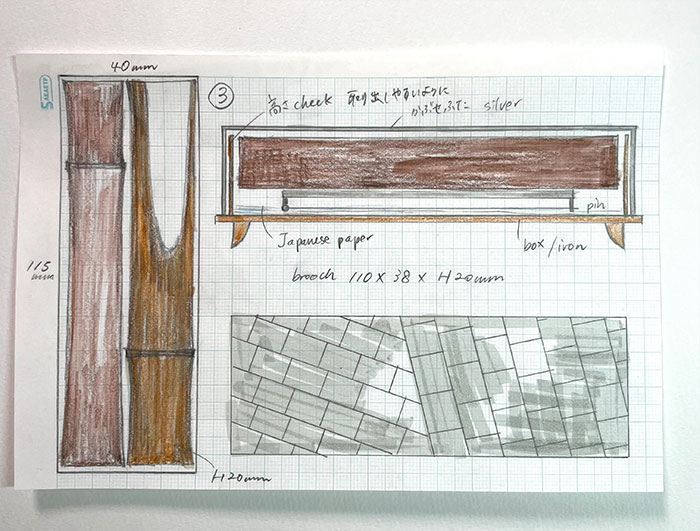
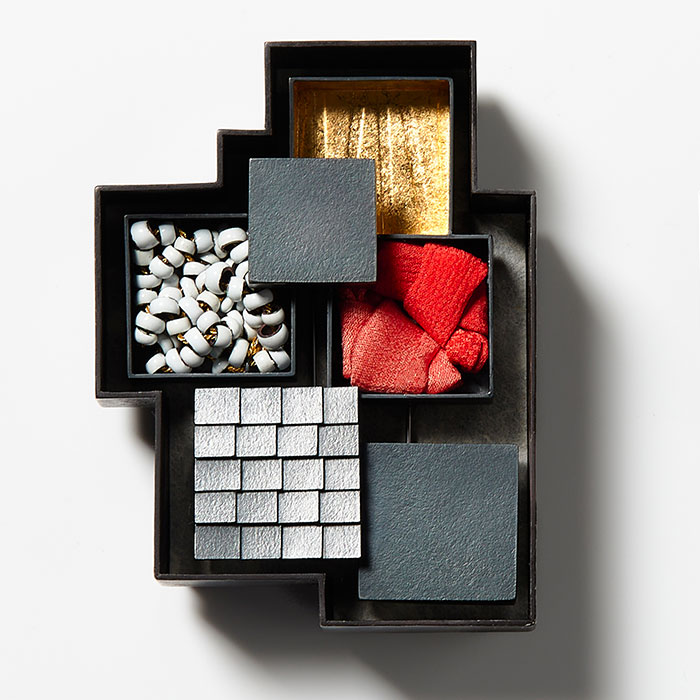
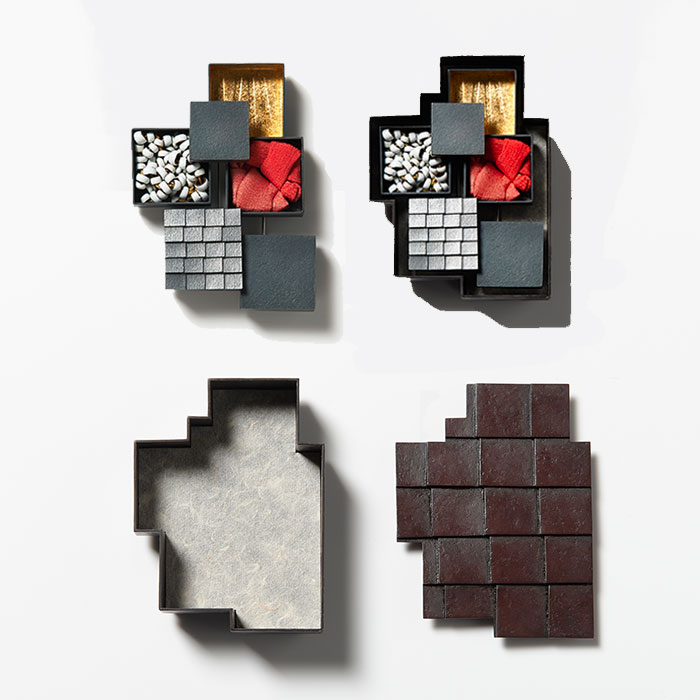
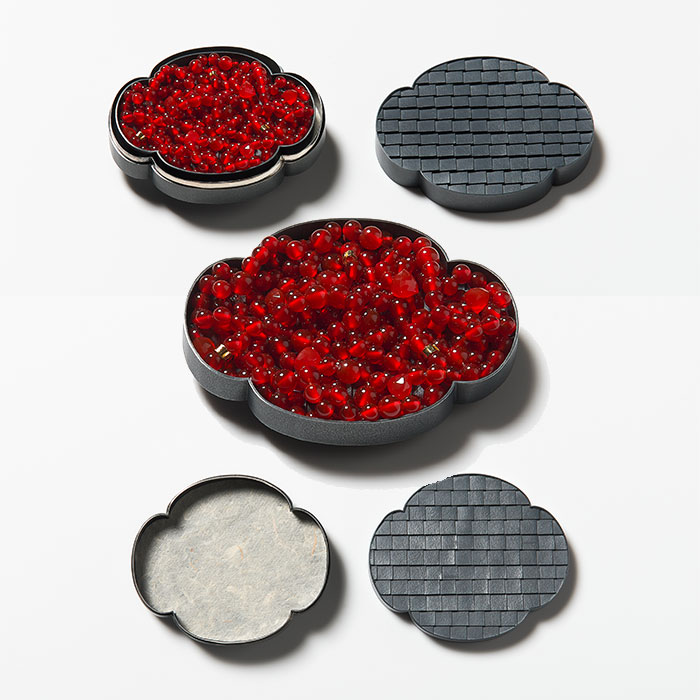
The arrangement of materials lies at the heart of Mariko Sumioka’s work. She conceives her jewelry as small, compartmentalized structures in which every element occupies a precise place. Metal, textiles, enamel, mother-of-pearl, and coral are not simply assembled: they are framed, sheltered, and sometimes concealed within a succession of miniature containers. The necklace Treasures, presented in the exhibition “Japan-Stillness and Substance”, gives this principle a particularly explicit form. For the same exhibition, the artist takes her exploration of containers even further. Drawing on the Japanese tradition of the tomobako (a box custom-made for a precious object) each of the four brooches she created is accompanied by a perfectly fitted case. When closed, the case hides the jewelry from view; when opened, it reveals the piece and showcases the diversity of its materials and techniques. The brooch can then be admired like a treasure. The case ceases to be mere packaging and becomes an integral part of the work. In A Roof Brooch on a Box, the distinction disappears entirely: the box itself becomes the jewelry.
Silk, Enamel, Pearls, Bamboo…
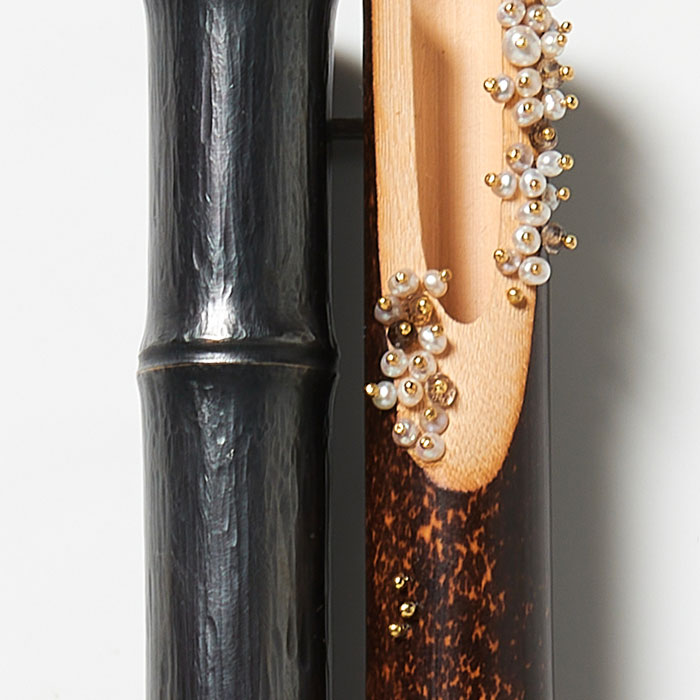
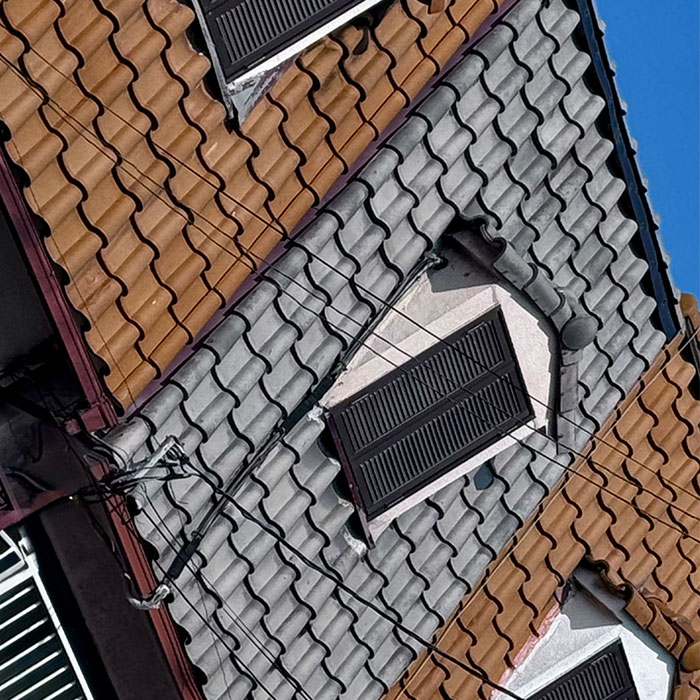
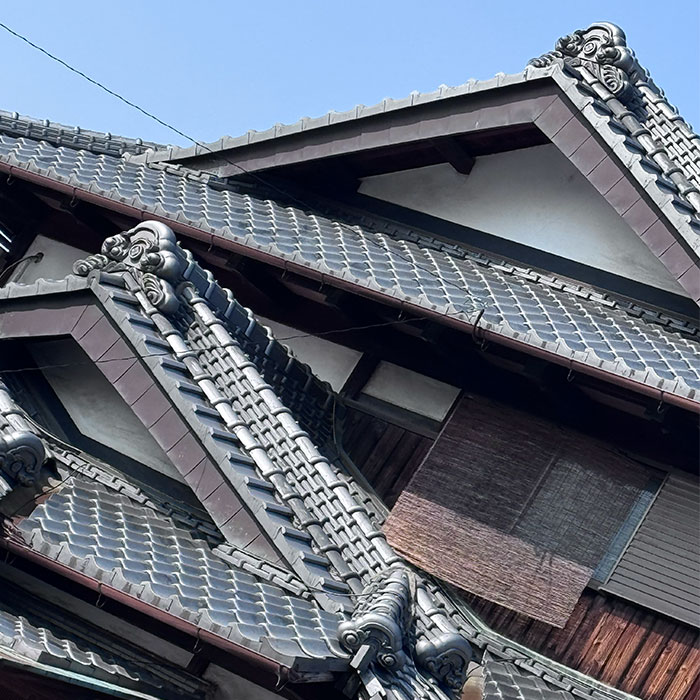
In Mariko Sumioka’s work, silver most often forms the underlying structure of the jewelry. “Its color and subtle texture bring softness and warmth to geometric forms,” she explains. She often runs it through a rolling mill with Japanese paper so that it retains the paper’s delicate imprint. She also oxidizes the metal to evoke the patinated surfaces of an old building. Enamel is her other material of choice. She uses it especially for the roof-tile motifs that have become emblematic of her work, as seen in the brooch A Roof Brooch on a Box. She also uses it to make her own “gems”: tiny beads cut from copper tubing and enameled by hand, one by one. Around these two materials, she deploys an endlessly rich repertoire: fragments of silk kimonos passed down by her grandmother, black or white mother-of-pearl, Nanhong—or southern red agate—gold leaf, coral, and more. Mariko Sumioka also enjoys playing with perception through trompe-l’œil. Two seemingly identical rods provide one example: the first is bamboo, while the second is made of oxidized copper and adorned with tiny natural pearls.
From Brazil to Scotland
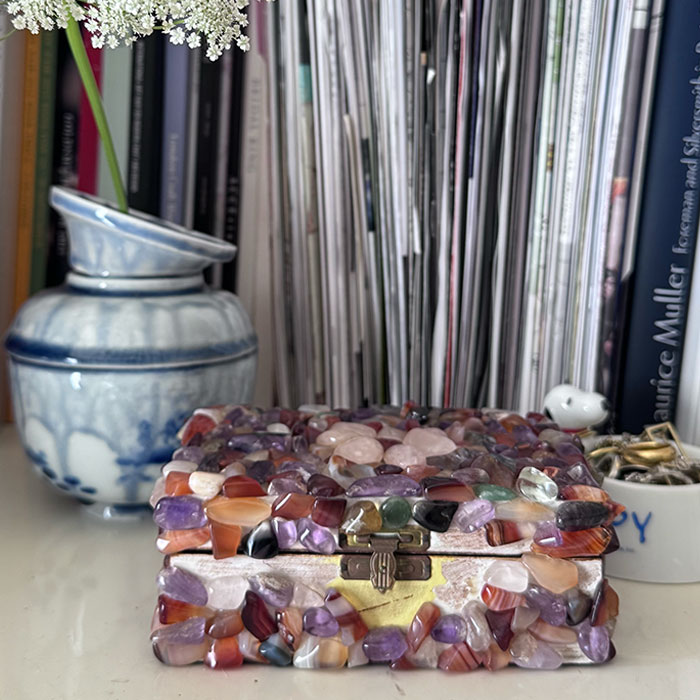
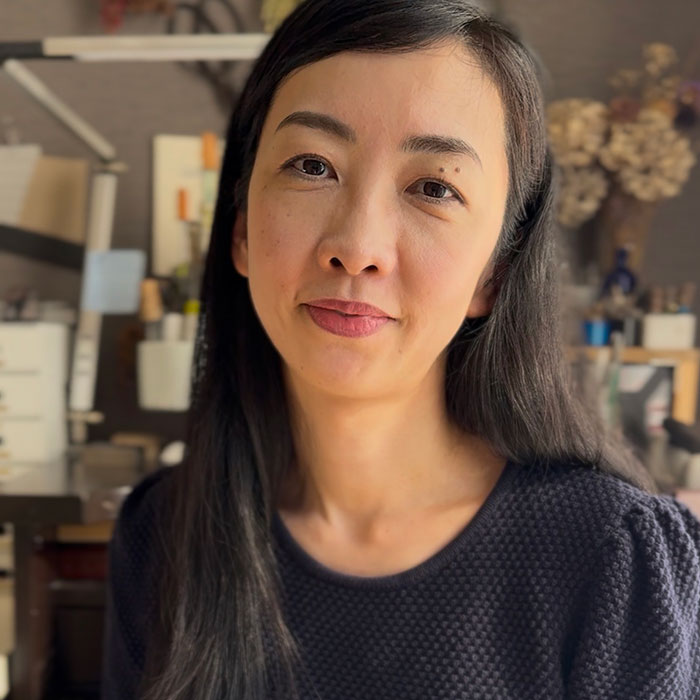
This affinity for materials and jewelry is deeply connected to the places where Mariko Sumioka has lived. She spent part of her childhood in Brazil, where her family moved because of her father’s work as an engineer in the silk industry. In kindergarten, she was fascinated by the gold earrings and bracelets set with colorful stones that her classmates were already wearing—a freedom that contrasted with Japanese customs, where jewelry is associated with adulthood. Around the same time, her father gave her a small jewelry box adorned with colorful gemstones. “I loved looking at each one, touching them, and removing them so I could admire them like treasures,” she tells me, showing me the object that still sits prominently on a shelf in her studio. “Even then, I pictured myself sitting at a workbench, creating jewelry.” Yielding to social pressure, she initially followed an entirely different path: a degree in economics at Osaka University, followed by a career in international investment in the oil and gas industries. But her calling never left her. She began secretly taking evening classes before leaving everything behind to attend the Edinburgh College of Art.
Rediscovering Japan
“Having traveled widely, I never developed a sense of belonging to any particular culture,” Mariko Sumioka says in flawless English. Paradoxically, it was in Scotland that she rediscovered her own culture: the tea ceremony; the dimness of traditional interiors; tatamiwari (畳割り), an architectural system that organizes a home’s floor plan around the module of the tatami; and the concept of ma, the interval that gives structure to a composition. Japanese references surface in her attention to materials, surfaces, natural hues, shadow and light, as well as the empty spaces that separate and connect forms. Her visual vocabulary also draws on the architectural landscapes that marked her youth: the small Japanese town where she grew up, with its roughly 300 tumuli, followed by Osaka, where she studied, and Tokyo, where she worked. During her daily train rides to Osaka University, she watched the small houses pass by. From a distance, they appeared like so many boxes, each sheltering a life. “I have always loved looking at what has been assembled and arranged inside, a little like a bento box.” This image of the box encapsulates her conception of jewelry and what architecture makes possible: sheltering materials, revealing their preciousness, and preserving their sense of mystery.
Banner image: A Bamboo Brooch in a Box, featured in the exhibition “Japan- Stillness and Substance”. Brooch: oxidized copper, oxidized silver, bamboo, freshwater pearl, smoky quartz, and 18-karat gold; box: patinated iron, silver, and Japanese paper.
Learn more about my exhibition “Japan, Stillness & Substance” (“Japon, Murmures et Matières) at Sotheby’s Paris from October 1–6, 2026, as part of Parcours Bijoux 2026, and explore Jewelry in Japan.
Opening talk (registration required) on October 1, 2026, at 6:00 p.m. at Sotheby’s Paris, with three of the artists in attendance : Aya Iwata, Mariko Sumioka, Shinji Nakaba.
This exhibition is part of Parcours Bijoux