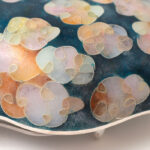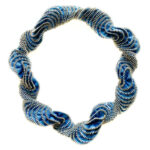



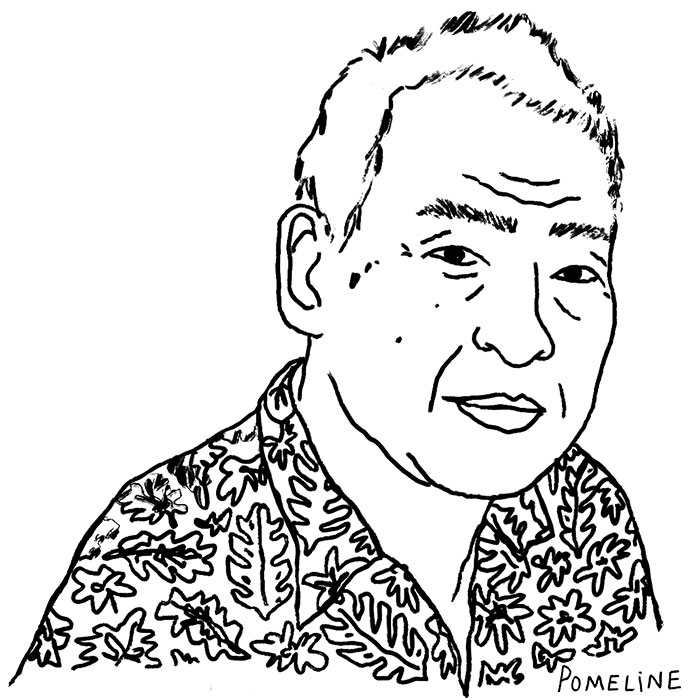
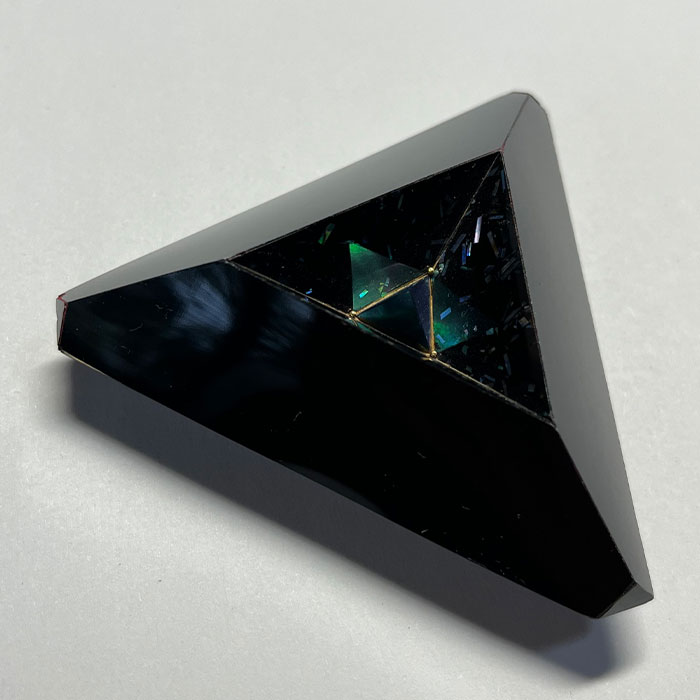

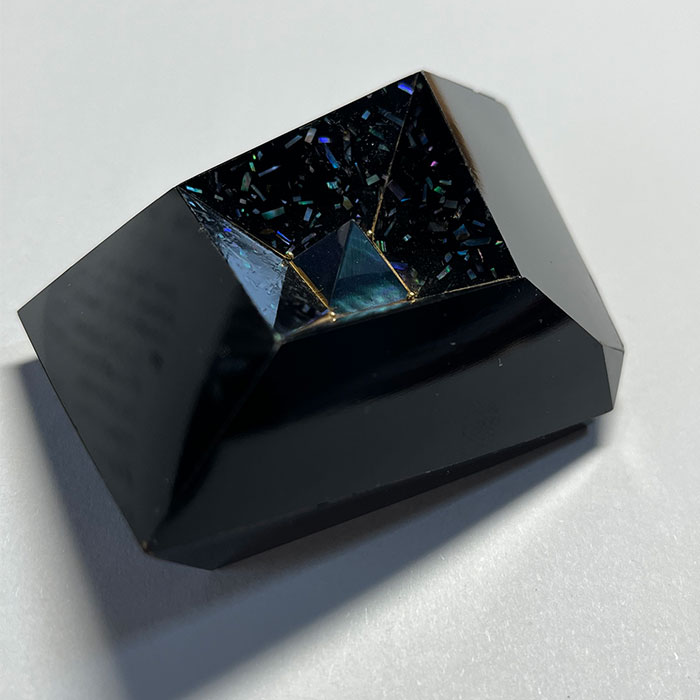
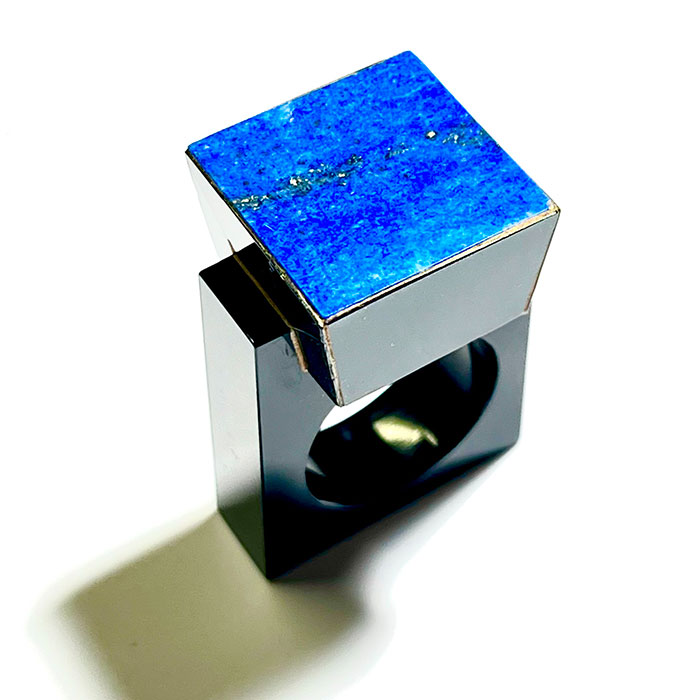
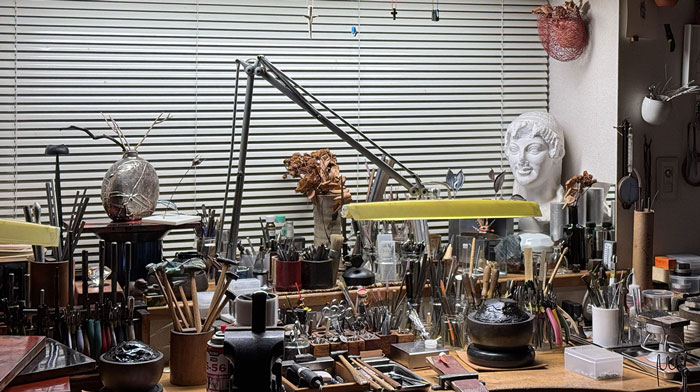
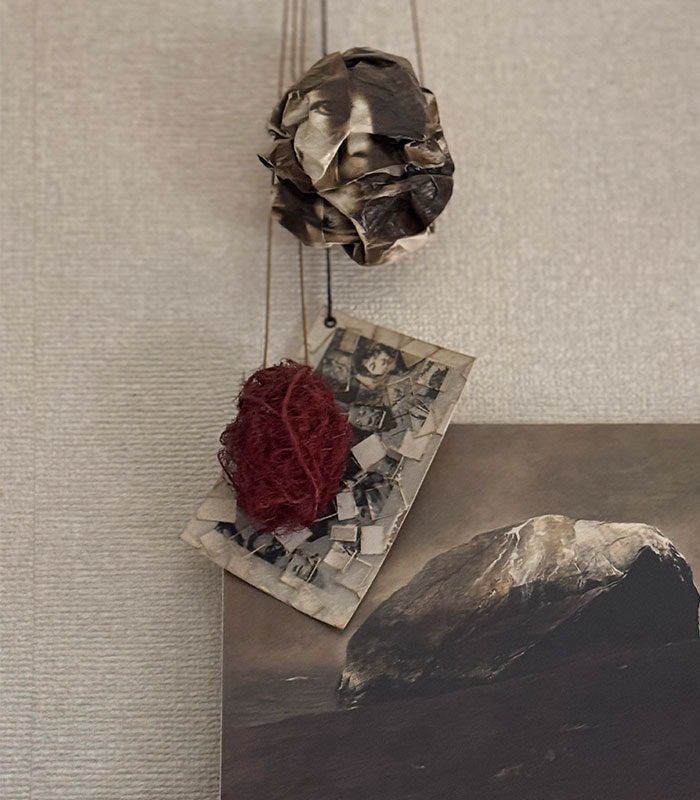
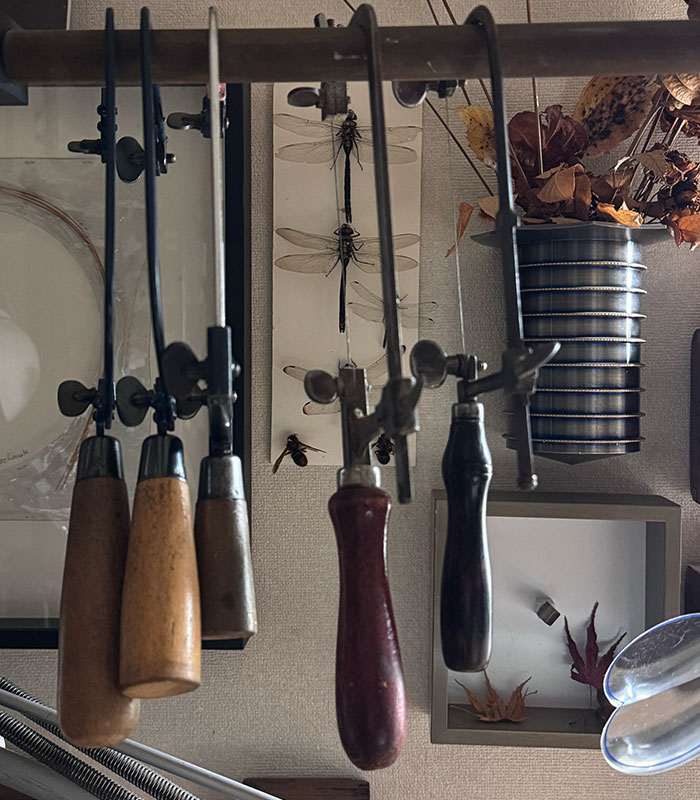
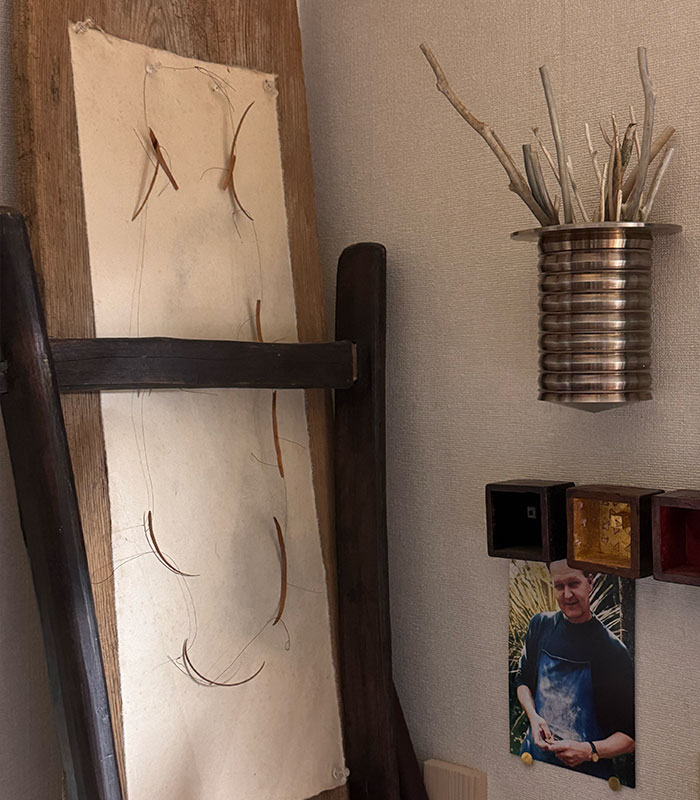
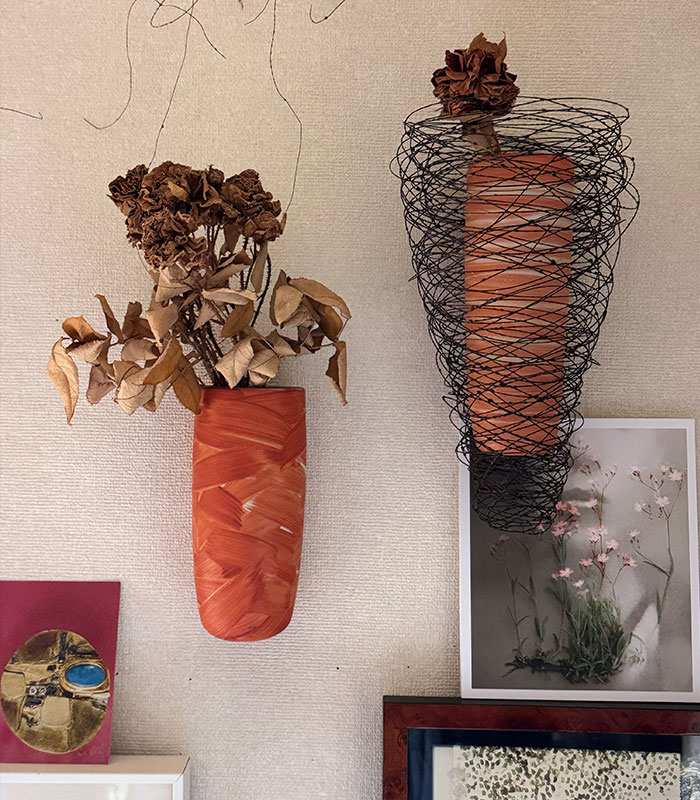
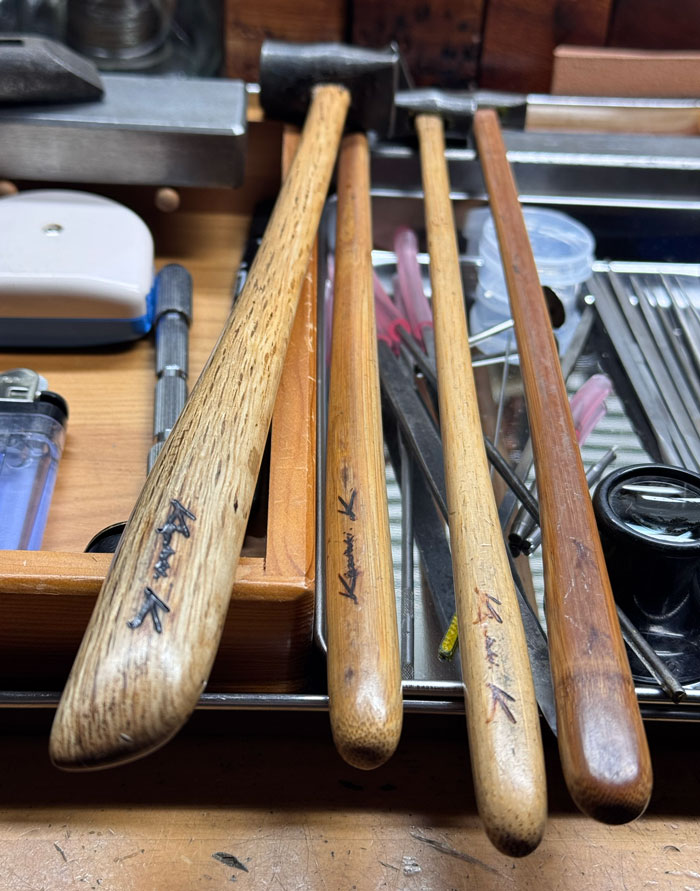
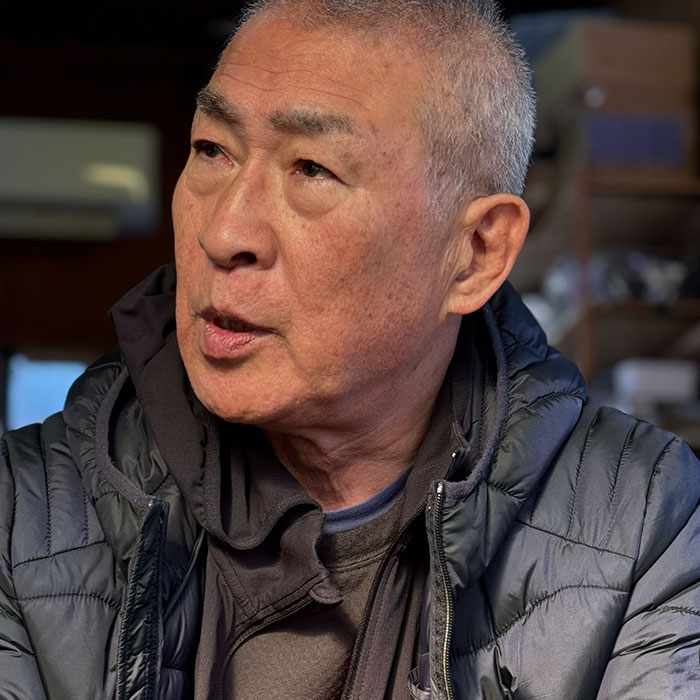
Silk threads, beads, fragments of lapis lazuli and coral, among countless other materials, quietly sketch a portrait of Kimiaki Kageyama. Each item, each fragment bears the trace of an experiment, a work or an encounter, telling the story of a lifetime devoted to experimenting, creating and passing on knowledge. It was during this extraordinary encounter, three years ago, that my interest in contemporary Japanese jewelry truly began.
Urushi: A Chance Discovery in the Studio
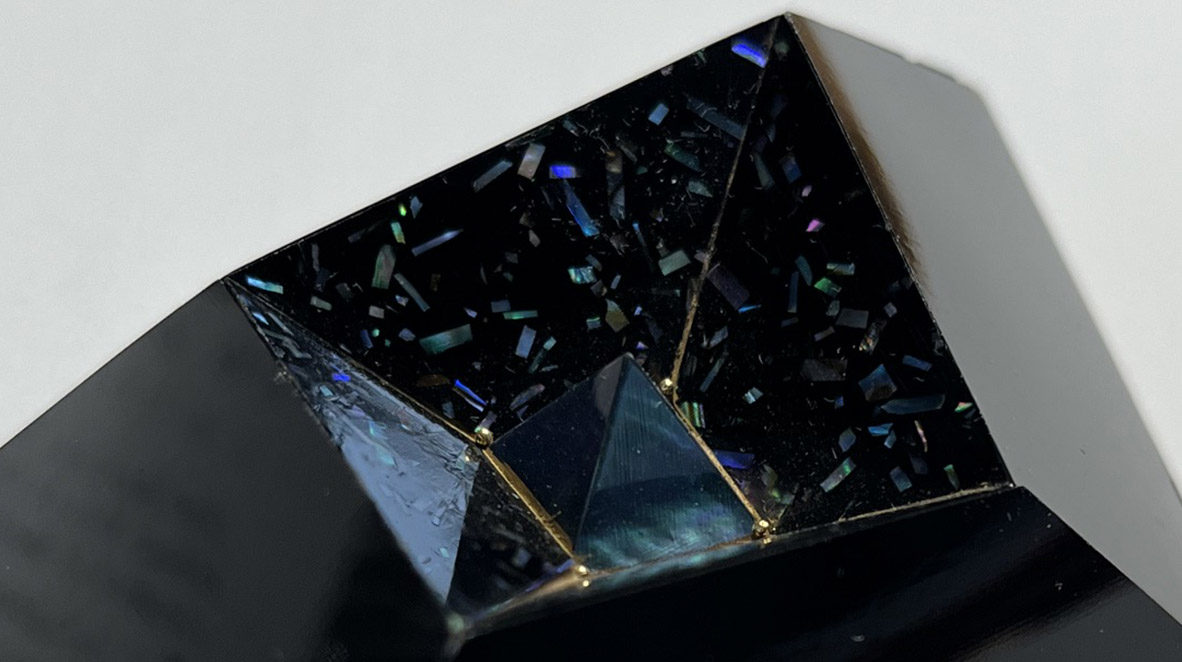
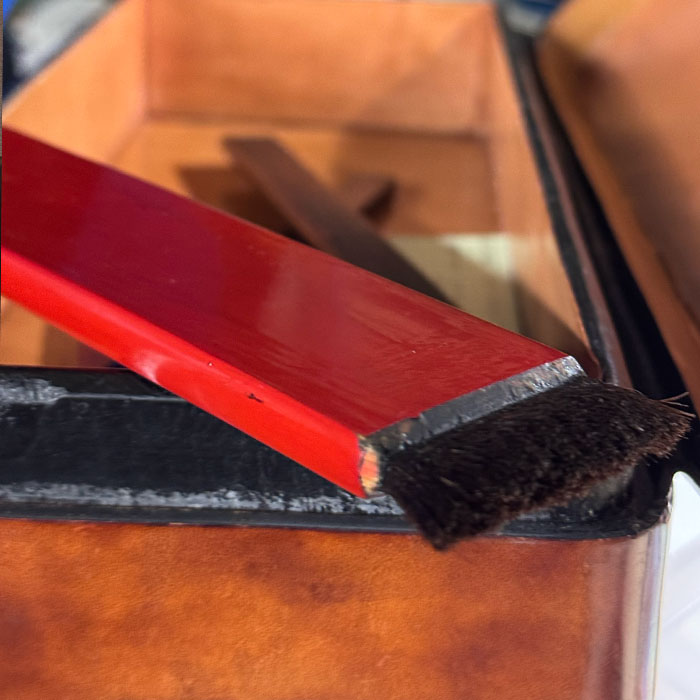
To create his two brooches and three rings, all cubic in form, Kimiaki Kageyama brought out some treasures: 300-year-old fragments of urushi lacquer from one of the three mikoshi—portable shrines—at Yasaka Shrine in Kyoto. When the mikoshi was restored, this natural material, made from tree sap, was stripped from the wood and discarded. Freed from its support, the dense, lustrous lacquer—deep black yet muted and patinated by time—enabled him to evoke the night sky as seen from his home. He punctuated it with cinnabar red, mother-of-pearl and pearls to suggest the sun, moon, nebulae and black holes. The luminous seams recall those of kintsugi [1]. Introduced to urushi in the early 1970s while studying at Tokyo University of the Arts, Kimiaki did not become interested in it until much later, following a chance occurrence in his studio. One day, a brush loaded with urushi grazed extremely fine metal wires suspended in space; the lacquer began to run, form droplets and then harden. This is how a large necklace came into being, composed of bundled urushi strands that fall fluidly along the body.
Master Goldsmith
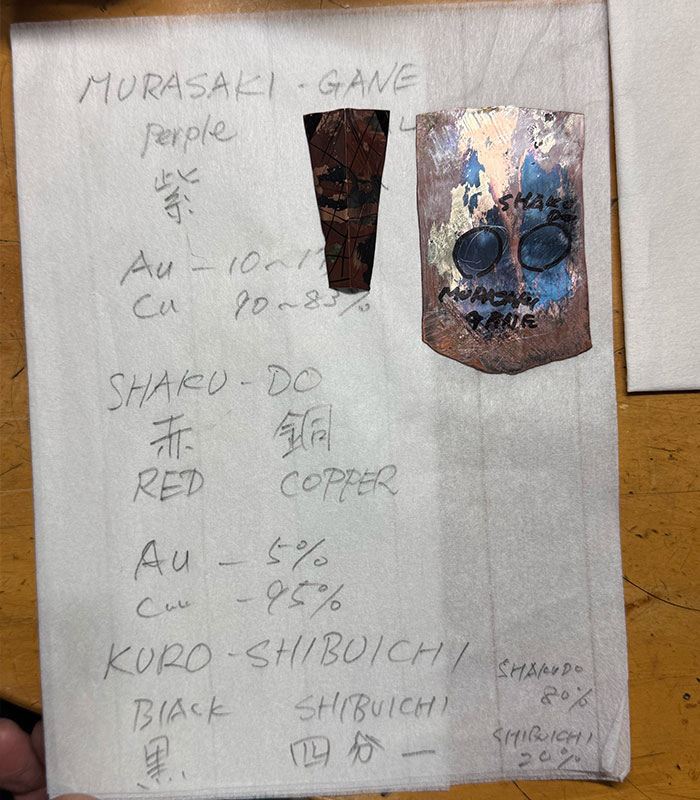
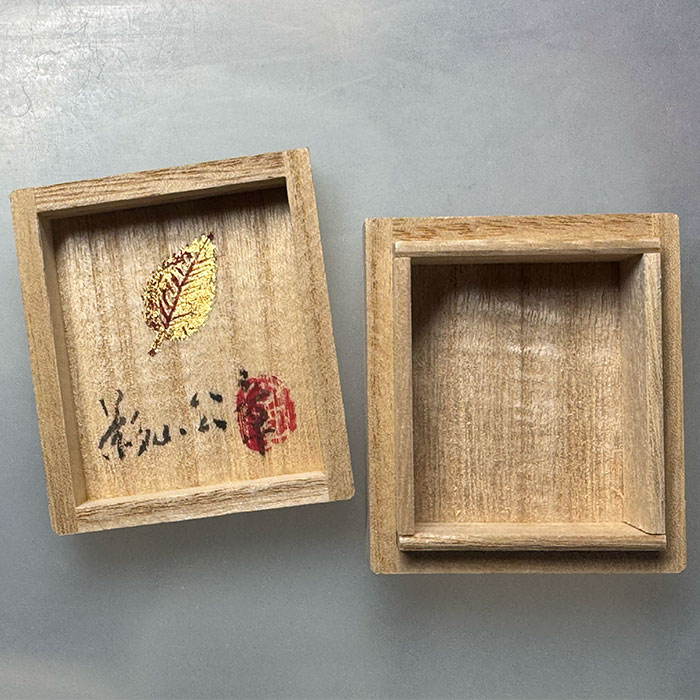
Kimiaki Kageyama readily describes himself as an experimenter, as the profusion of materials preserved in his studio attests. Yet metalworking remains the foundation of his practice. He is one of the experts who have mastered the alloys historically associated with Japanese sword fittings. On the day of my visit, he demonstrated how to make shakudō, an alloy composed primarily of copper with a small proportion of gold. Once patinated, it develops a deep black hue with bluish highlights. This virtuosity enables him to render, with almost tactile precision, the delicacy of a leaf vein, the fragility of a fallen leaf or the quiver of a petal. A frost-covered leaf, picked up during a walk with his daughter, can thus become the starting point for a lengthy creative process. Yet his brooches depicting leaves, flowers and twigs are not simply naturalistic: they lend a paradoxical permanence to what is destined to grow, wither and disappear. In his hands, metal transcends botanical imitation to acquire a presence of its own.
A Champion of Contemporary Jewelry
Kimiaki Kageyama’s role in contemporary jewelry extends well beyond his own artistic output. From the outset, he worked in collective settings where the boundaries between jewelry, sculpture, graphic design and metalwork remained fluid. After completing his studies, he co-founded Supermouse, a multidisciplinary studio that brought together metal artists, a graphic designer and a sculptor to create gates and signs. It was during this period that he began making jewelry. He later contributed to the development of jewelry drawing and design education at Hiko Mizuno College of Jewelry. Deeply committed to his students, he supports them in making, presenting and promoting their work. In this context, he developed ties with international artists who were equally committed to teaching, including the celebrated Otto Künzli and Bernhard Schobinger. This commitment to passing on knowledge continues through the workshops on Japanese techniques that he regularly leads abroad.* Through him, techniques circulate, enter into dialogue with other practices and evolve.
[1] Kintsugi (金継ぎ, “golden joinery”) is a Japanese art that consists of repairing broken ceramics with urushi lacquer, then highlighting their fracture lines with powdered gold. Rather than concealing the breaks, the practice incorporates them into the object’s history and aesthetic.
*In partnership with Elemento, a Paris-based jewelry school, PARCOURS BIJOUX is offering two three-day introductory workshops in Japanese techniques with Master Kageyama. They will take place on October 17–19 and 23–25, 2026.
Learn more about my exhibition “Japan, Stillness & Substance” (“Japon, Murmures et Matières) at Sotheby’s Paris held at Sotheby’s Paris from October 1–6, 2026, as part of Parcours Bijoux 2026, and explore Jewelry in Japan.
Opening talk (registration required) on October 1, 2026, at 6:00 p.m. at Sotheby’s Paris, with three of the artists in attendance : Mariko Sumioka, Shinji Nakaba, Aya Iwata.
This exhibition is part of Parcours Bijoux