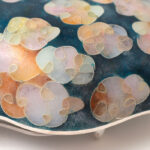



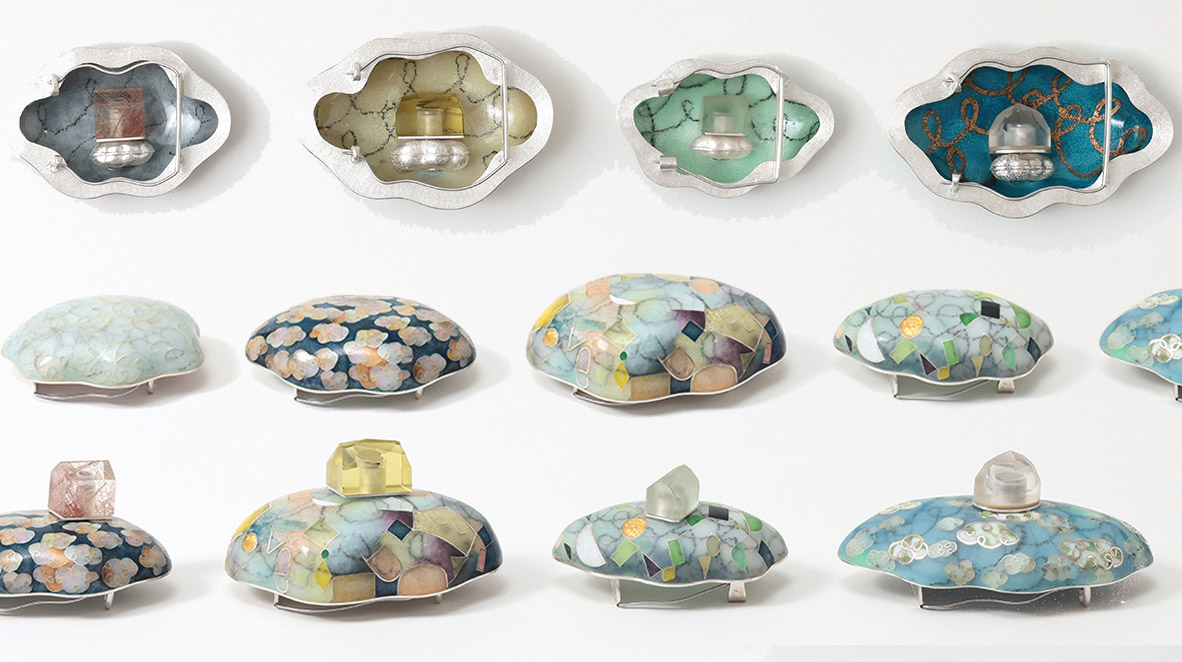
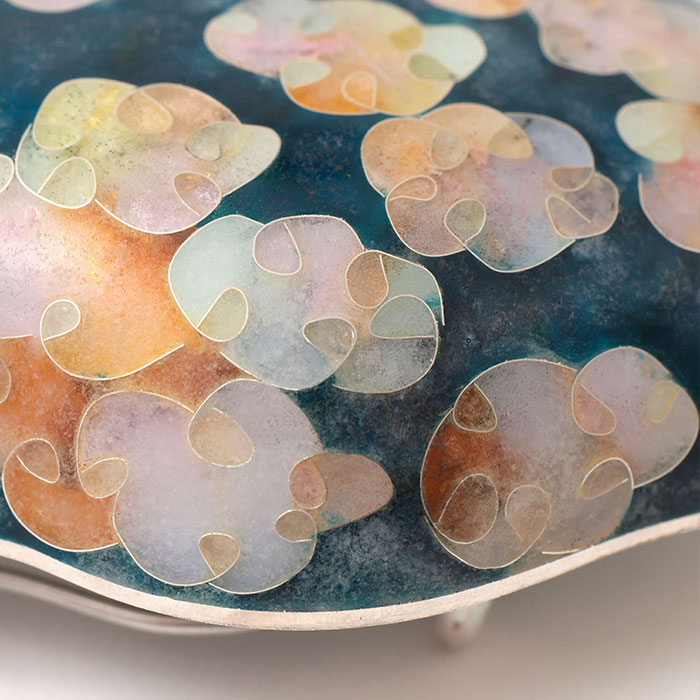
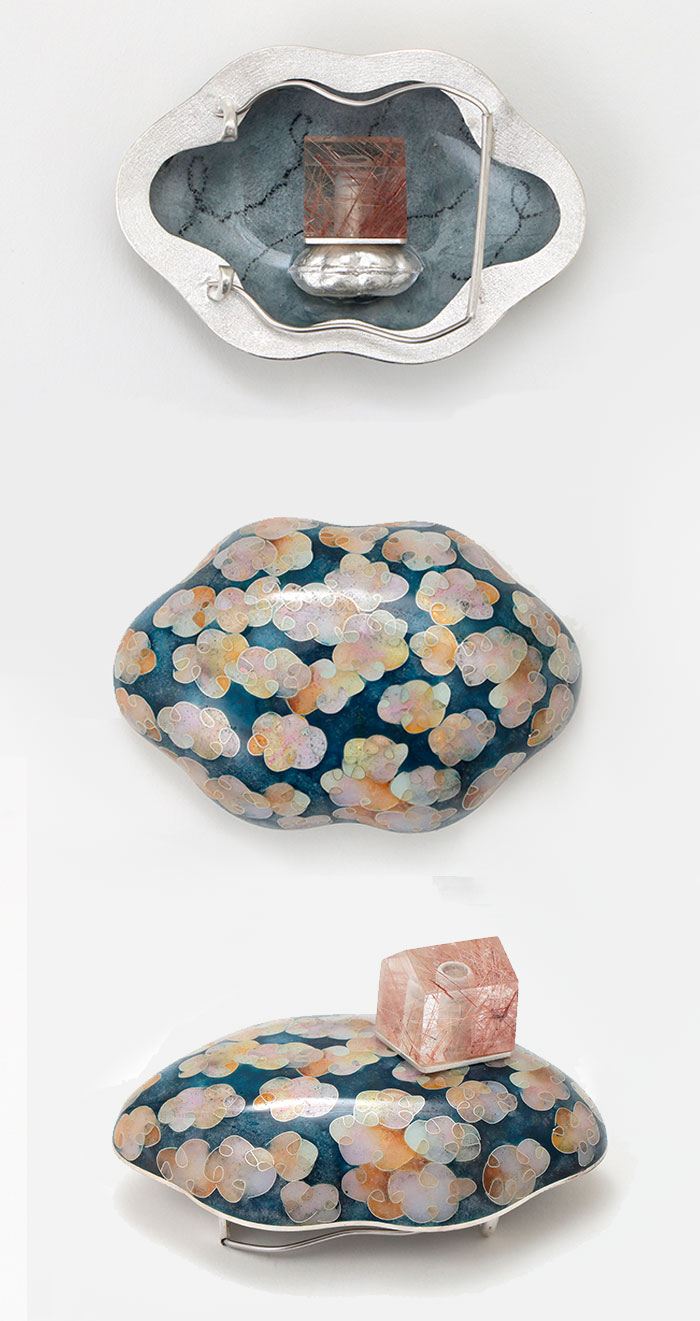
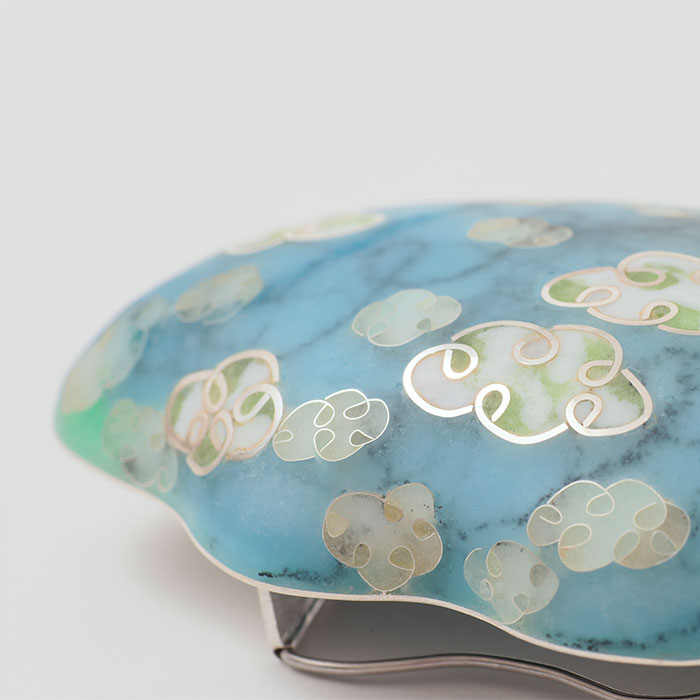
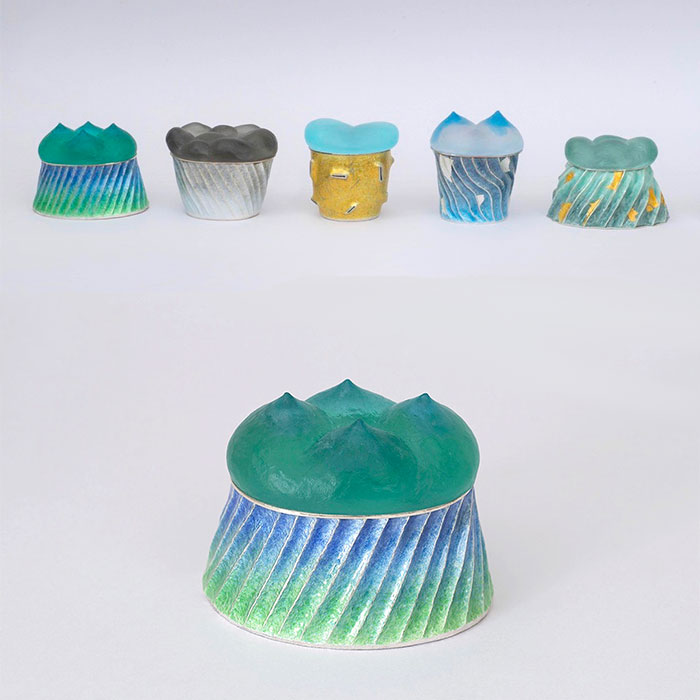
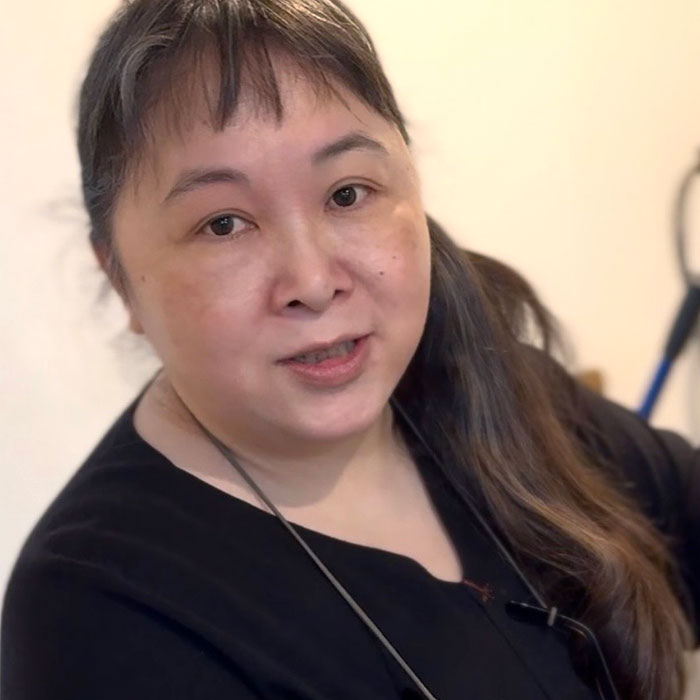
What do we preserve of someone we love? What do we leave to those who will outlive us? How can an object hold a presence and give memory a form capable of sustaining the bond? Aya Iwata answers these questions through her Kumonoie: small house-shaped urns that, over time, have become pieces of jewelry. Last April, I visited Aya Iwata in her Tokyo studio. For nearly 30 years, she has been developing her Kumonoie—literally, “Houses in the Clouds”—objects and jewelry made of fine silver, cloisonné enamel, and pâte de verre. This body of work is shaped by loss, memory, and legacy. For the exhibition “Japan – Stillness and Substance” (“Japon, Murmures et Matières”), she presents a variation consisting of five brooches: “The five brooches I created for the exhibition each stand on their own, but together they form a sequence tracing the universal cycle of life. Each is associated with a date, a specific moment in my life, except for the last one: it evokes the day when I will look down upon the world from heaven, beside my mother. Together, we will watch life continue on its course.”
The Birth of the Kumonoie
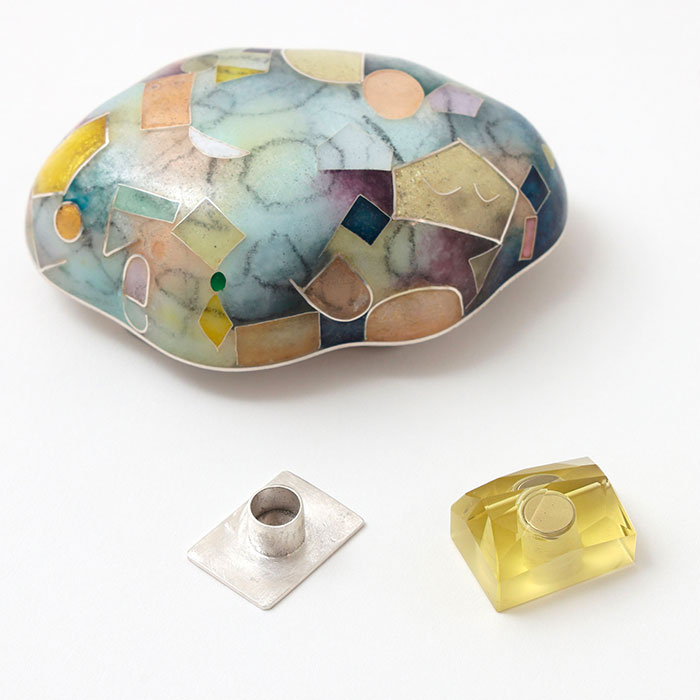
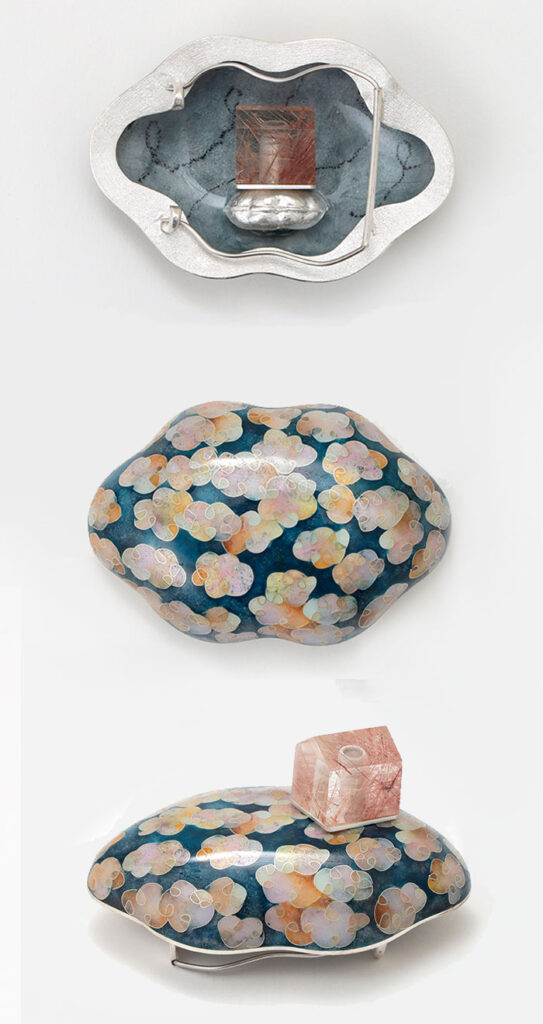
Aya Iwata’s Christian faith directly informs her reflections on loss, love, and the enduring bond between the living and the dead. She was still a student when her mother died in 1991. For two years, she kept the funeral urn close to her, even taking it with her on her travels. She eventually entrusted it to her church for burial, but her sense of loss did not diminish. To come to terms with the fear of death she had carried since childhood, Aya Iwata imagined small urns capable of holding a portion of the ashes, as well as, symbolically, the memories and presence of the deceased. Their pâte de verrelids, shaped like clouds, protect without confining: they suggest a passage rather than a final separation. These early Kumonoie found a natural extension in brooches, which are more intimate and easier to wear. Nestled on the reverse are a miniature silver cloud and a tiny house carved from quartz [1]. The brooch thus becomes a talisman, a portable dwelling inhabited by memories, love, and unseen presences.
Silver and Enamel: Spiritual Depth
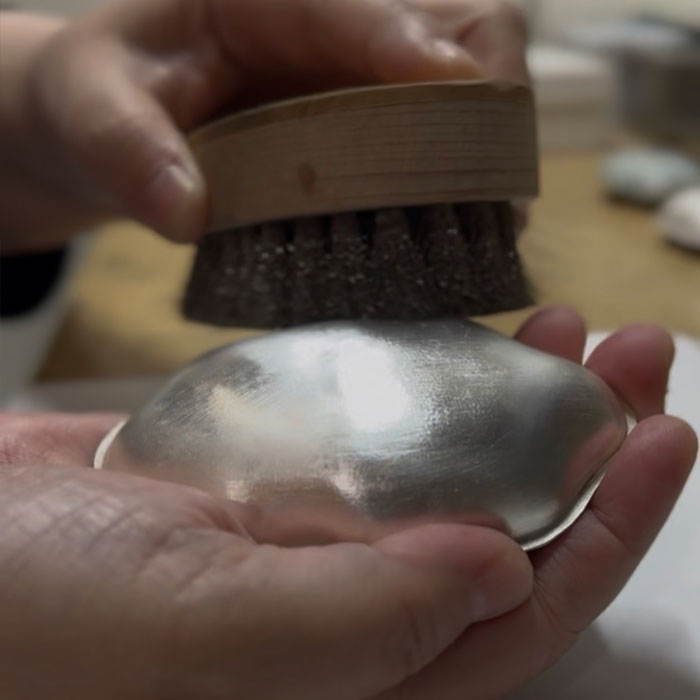
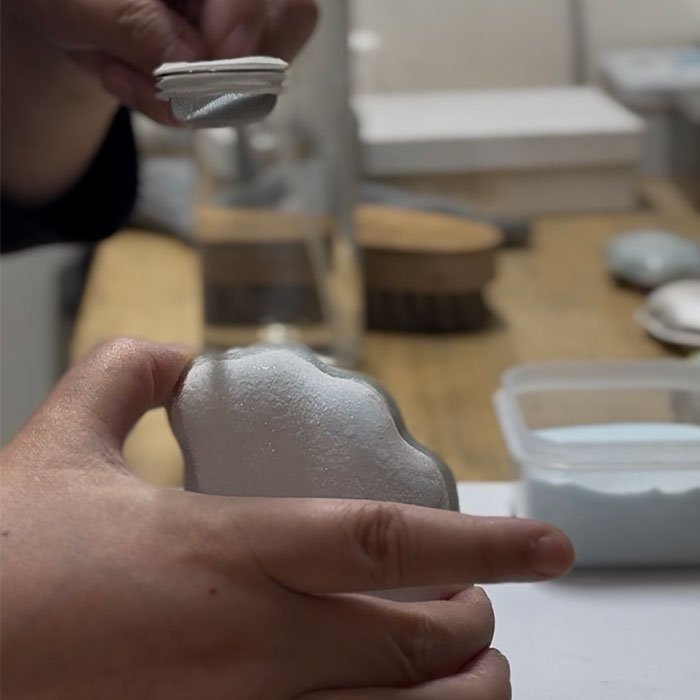
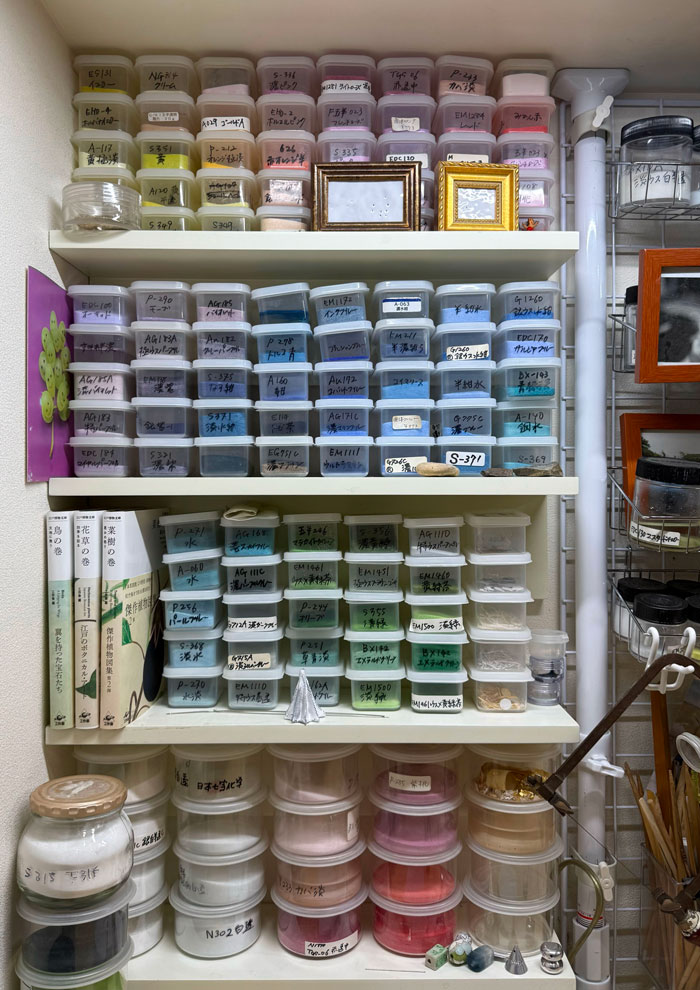
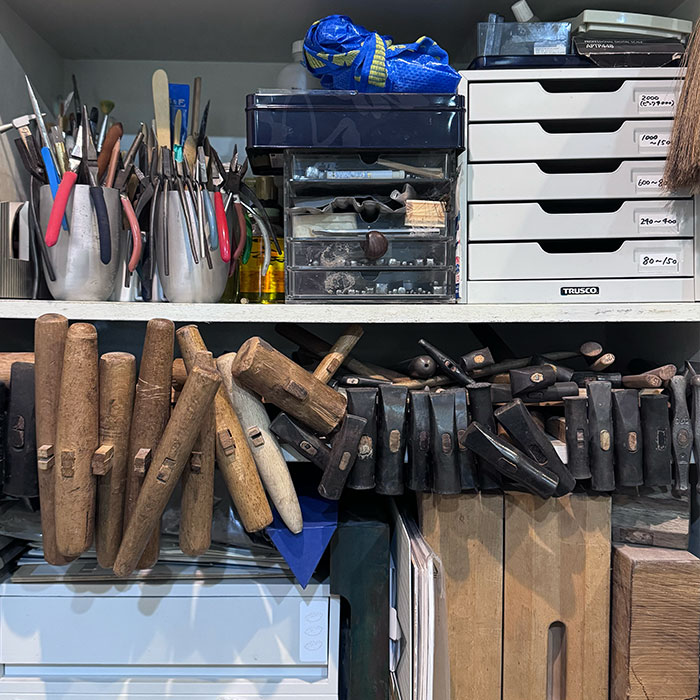
Her parents, both artists and teachers, introduced her to materials and creative processes at a very early age. “At the age of four, I was already experimenting freely, which led me to create my first piece of cloisonné enamel. Its brilliance fascinated me.” At Tokyo University of the Arts, she studied sculpture and metalwork before further exploring Japanese cloisonné enamel (yūsen shippō), a technique refined to an exceptional degree during the Meiji period (1868–1912). This dual training enables her to carry out every stage of her Kumonoie herself. She works sheets of fine silver, chosen for their malleability, then cuts and shapes them into three-dimensional forms. The different components are joined using 85% silver solder. On the surface, she outlines the cells that will receive the powdered enamel using extremely fine ribbons of silver. “It is a traditional technique, but over time I have made the process my own. I repeat the gestures and build up the layers to create depth,” she explains. Between each layer, patient polishing of the enamel reveals the brilliant whiteness of the silver and gives the colors their distinctive depth, at once poetic and celestial. Never conceived as mere decorative effects, the patterns and tones emerge intuitively, guided by her inner state and the material’s reactions. For her, “working with silver and enamel has become as natural as breathing.”
Enamel: A Technique Reimagined
“When I invited her to take part in the exhibition Conversation at the Musée des Beaux-Arts de Limoges in 2022, my intention was to place her contemporary practice in dialogue with the museum’s historic collections and to show how far enamel techniques could be pushed, hybridized, and renewed. Her imagination, patience, color choices, and the delicacy of her patterns transform technical prowess into an artistic language,” explains Lise Rathonie, then president of the Syndicat Professionnel des Émailleurs Français (SPEF) [2]. In 2023, following the exhibition, the Musée des Beaux-Arts acquired a Kumonoie created in 2020. The work joined a collection of more than 600 pieces tracing the production of Limousin workshops from the Middle Ages to the present day. Through its form and symbolic function, this Kumonoie echoes two types of precious containers found in the museum’s collections: the medieval reliquary, often designed as a small architectural structure intended to house a saint’s relics; and the pyx, a lidded liturgical vessel used in particular to hold consecrated hosts. In 2024, Aya Iwata donated a Kumonoie to the Archdiocese of Palermo. Its silver wires depict waves, ships, fish, the deer of Yakushima, and birds crossing the sky. The work was created for the beatification of Father Giovanni Battista Sidoti, a Sicilian missionary who secretly landed on Yakushima Island in 1708, at a time when Christianity was banned in Japan.
Traditionally decorative, enamel becomes, in Aya Iwata’s hands, an intimate material charged with memory and emotion.
[1] A stone traditionally associated with clarity, purification, and protection.
[2] The exhibition Conversation, held at the Musée des Beaux-Arts de Limoges from May 21 to November 7, 2022, was part of Impertinente. La Rencontre émail & métal. See Jean-Marc Ferrer and Lise Rathonie (eds.), Impertinente. La Rencontre émail & métal, exhibition catalog, Limoges, SPEF–Les Ardents Éditeurs, 2022, 288 pp., ISBN 978-2-9582621-0-5.
Learn more about my exhibition “Japan, Stillness & Substance” (“Japon, Murmures et Matières”) at Sotheby’s Paris held at Sotheby’s Paris from October 1–6, 2026, as part of Parcours Bijoux 2026, and explore Jewelry in Japan.
Opening talk (registration required) on October 1, 2026, at 6:00 p.m. at Sotheby’s Paris, with three of the artists in attendance : Aya Iwata, Mariko Sumioka, Shinji Nakaba.